Max Lawrence Writes

  • At Christmas play and make good cheer…

    Nov 21st, 2023

    …For Christmas comes but once a year.
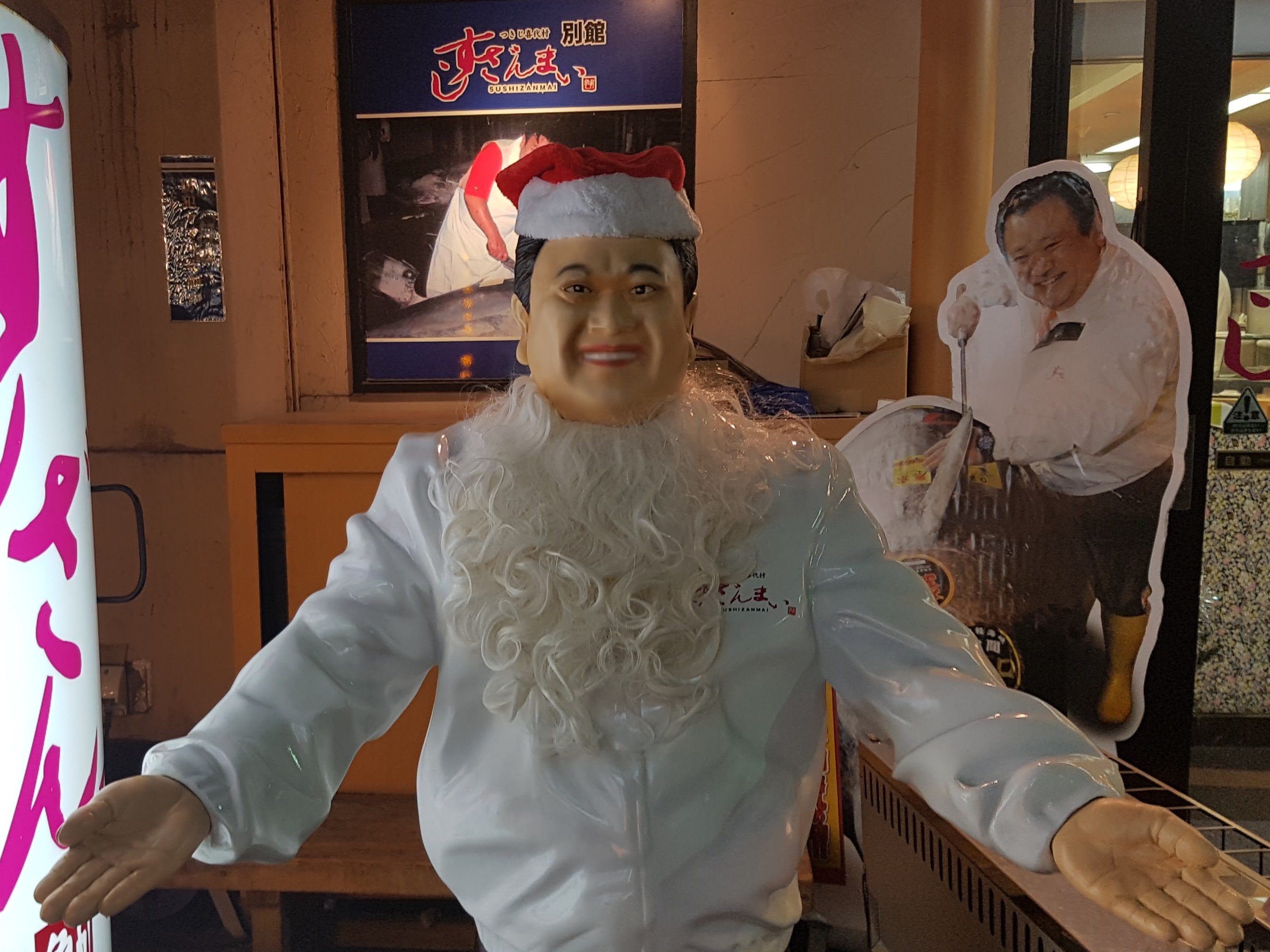
    Recently I’ve had to make a very difficult decision, one that has brought me little joy. Do I return home for Christmas and the new year, or do I see through my favourite time of year on my own, on the other side of the world? Choosing the latter would make this my second ever Christmas away from home, and my first ever Christmas entirely alone. No bacon sandwiches and prosecco for breakfast, no afternoon snoozing on a toasty sofa, no reasoning with myself to have one more beer ‘because it’s Christmas’ (‘It’s five o’clock somewhere!). Well, maybe a bit of that. Choosing the former would mean an arduous, expensive and thoroughly worthwhile holiday in Rushden, Brixworth and ‘Faaampton. A quandry, for sure, but let’s ground ourselves first.

    I have recently enjoyed lengthy soujourns in Malaysia and Thailand. Malaysia has much going for it; excellent, albeit diabetes-inducing, food, the kindest people and incredible natural beauty.

    • It’s a dusky leaf monkey and, well, d’awwww… (Dusky Leaf Monkey – Facts, Diet, Habitat & Pictures on Animalia.bio)

    Malaysia also has its downsides, such as exorbitant drink prices (like London, but in South East Asia, which frankly isn’t acceptable), an arbitrarily awkward and often broken train system (I’m looking at you Kuala Lumpur) and it can be a pedestrian’s worst nightmare when it comes to roads and walkways (again, Kuala Lumpur specifically. Penang and Langkawi were a’ight). 

    It’s a fascinating country. One where you can walk a single stretch of (challenging) road and encounter a masjid, a Taoist temple, a Buddhist temple, an Anglican church and a gurdwara in the course of a few minutes. Due to the many and varied communities, English is generally the go-to language, making it easier to navigate for those of us fortunate enough to be born in an English-speaking country. It is a muslim nation, hence the hefty taxation applied to the sinful sauce (sin tax era = syntax error), resounding calls to prayer and abundance of delicious curries, breads and fried goodness. And the people! So helpful and friendly; I was given lifts when the daily hammering rain made my journey difficult, taken to my favourite of all things, a free buffet, and given assistance countless times, which more than made up for any shortcomings. It was nice to spend time in a mostly booze-free environment too. Fresh fruit smoothies at dusk and waking up clear of head and free of regret? More of that please.

    Thailand, specifically Chiang Mai, was a joy. I met a group of beautiful, wonderful people at the guest house in which I was staying, and we bonded over morning yoga, coffee in the courtyard and piles of delicious scran. It was the kind of experience that makes you ponder the possibility of divine forces at play, a once-in-a-lifetime union, entirely by chance, that leaves you simultaneously with a heart full of gratitude and, upon leaving, a friend-shaped hole in your soul (our soul?). 
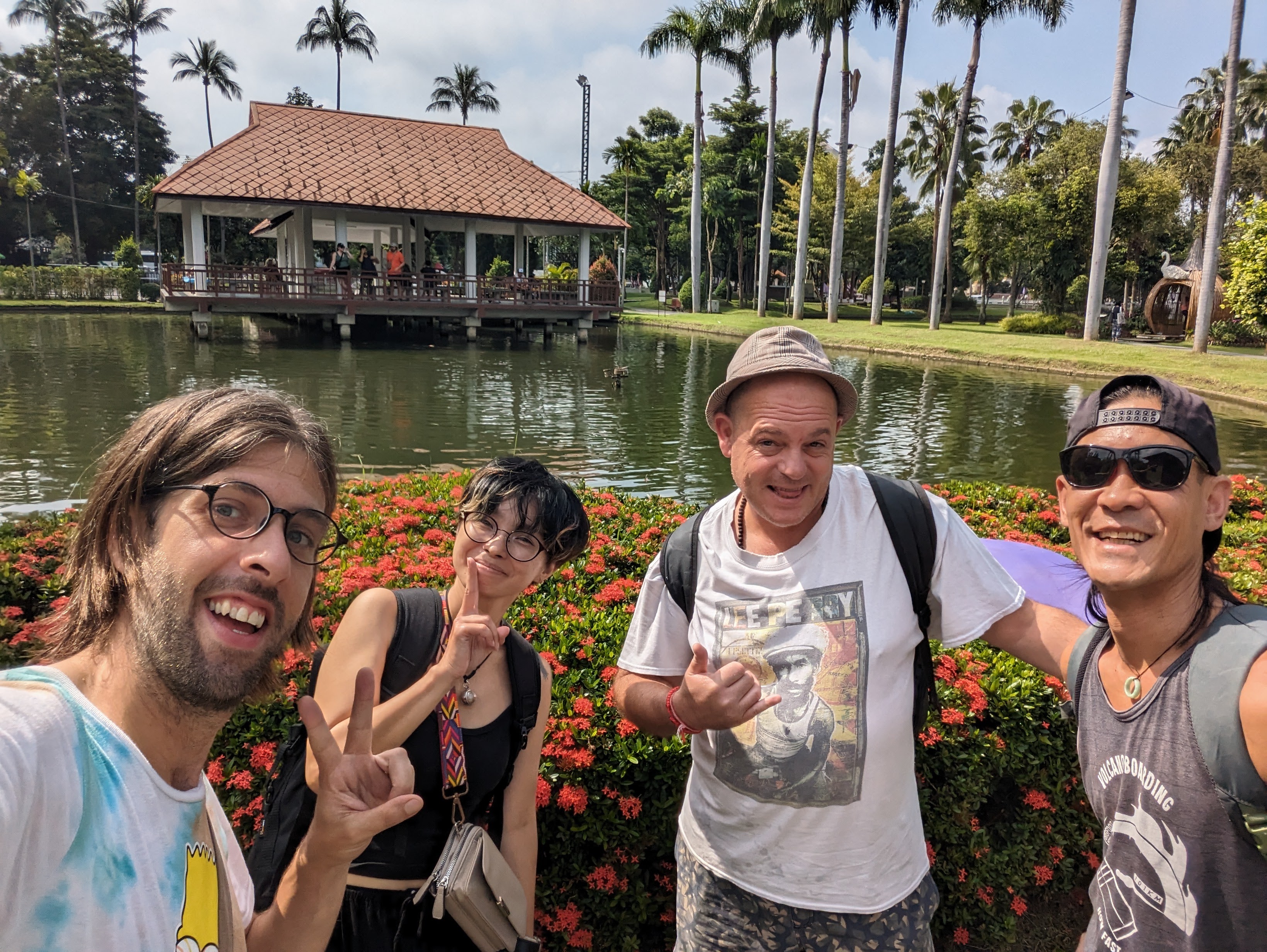
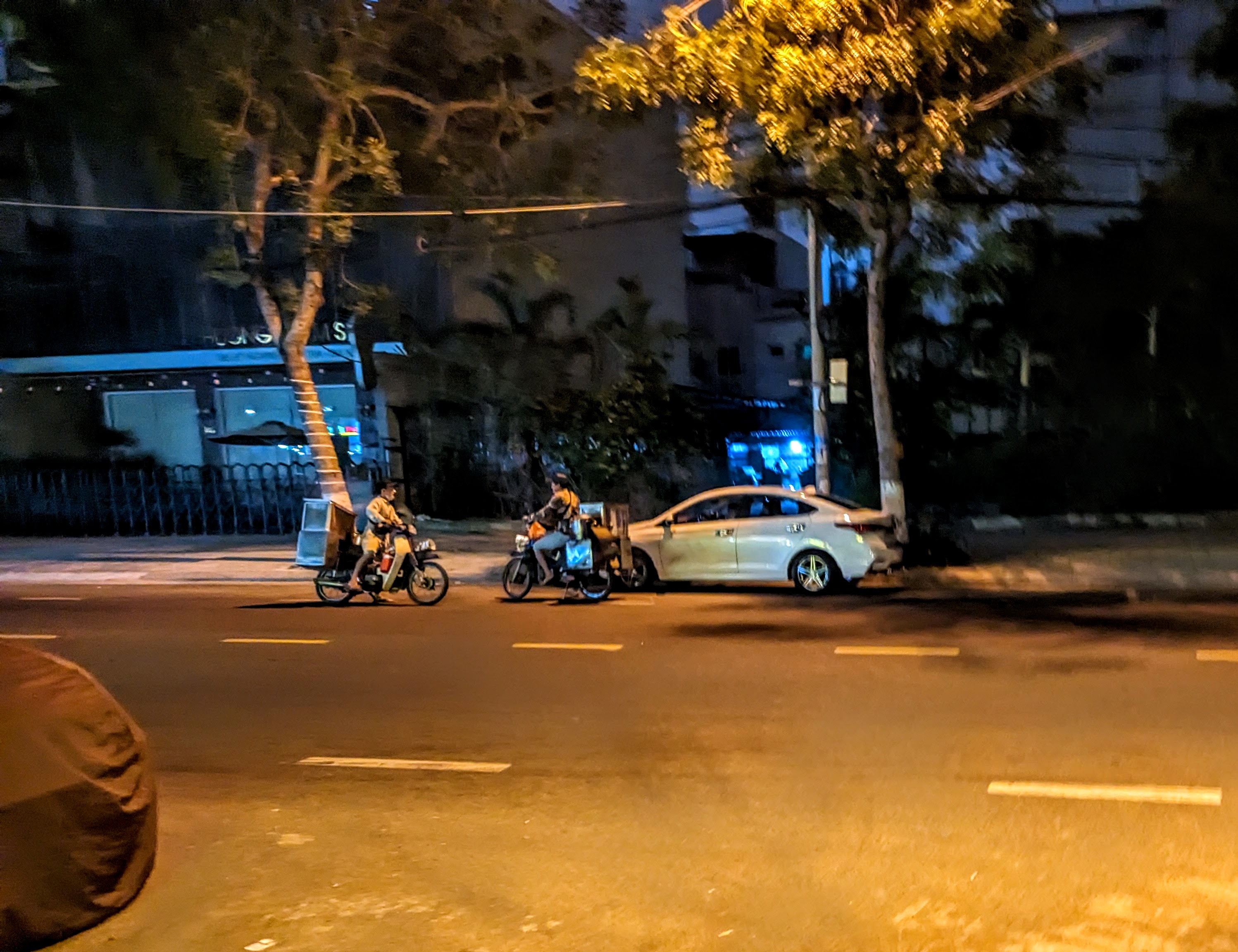
    Which was fortunate, because without them, Chiang Mai would have sent me off the rails. Cheap booze? Check. An ever-flowing river of English-speaking party people? Check. Confidence-boosting compliments received daily from the various ladies outside the massage parlours on Loi Kroh road? Check (apparently I’m quite the catch). Gorgeous countryside on the doorstep? Check. However, there is a tragic and infuriating hollowness to facets of the city’s ‘culture’.

    I am always of the mindset that people have the liberty to do what they please, when they please, as long as it does no harm, however seeing the elderly men sitting with beautiful young Thai women, simultaneously enjoying an evening of boozy fun, whilst also ‘fluffing the pillow’ at tremendous cost in anticipation of the inevitable grunting, spluttering conclusion leaves me feeling jaded. How easy it would perhaps be, when advancing in years, finding yourself bereft of kith and kin, to slip into such habits. In addition, having spent a weekend bar-hopping and meeting several typical Thailand-loving ‘revellers’ (Hugh, Hugh and Hugh I think they were called) face-to-face, it’s safe to say that many of them are rather tedious individuals, to my mind. No doubt they found me similarly tedious, however it has reinforced an extra caveat to my long-held mindset. Do what you please, when you please, but do it far away from me, you absolute helmet. 

    Thailand is a beautiful country with genuinely lovely people and it’s unfortunate that they have suffered various misfortunes that have led them to the position of relying so heavily on tourism. I was there in 2013 and, sadly, little seems to have changed in terms of the socio-economic disparity in those ten years. 

    So, heart laden with positive love and negative opinions (ugh, opinions, and on the internet too, base communication at its lowest), I hopped on a flight to Japan with a full, yet fleeting, itinerary. Osaka – Tokyo – Sapporo – back to Vietnam early December.

    By the grace of the gods of Japanese immigration, I was granted a visa once again, just under a month ago, despite arguably taking the proverbial with my repeated and extended stays.

    As this missive grows in length, your attention likely diminishes (listen to him whine, oh, woe is he) so I’ll cover my various and oft-wayward antics in a different post. 

    Back to the main question. 

    Christmas comes but once year…

    Skip to the end, I eventually made it back to Sapporo and immediately upon exiting the central train station to a welcome party of howling Arctic winds and streets damp with fresh-fallen rain, I felt my heart swell with contentment once again. Having left my Chiang Mai posse (Crew? Cru-dem? Coterie?)  and found little in the way of genuine (if intangible) warmth in either Osaka or Tokyo, I was feeling a little lost. An Instagram post announcing my long-anticipated return garnered numerous responses from Sapporeans that I have come to call friends*. I felt ‘at home’ again. Second home, of course, but it’s nice to feel welcome.
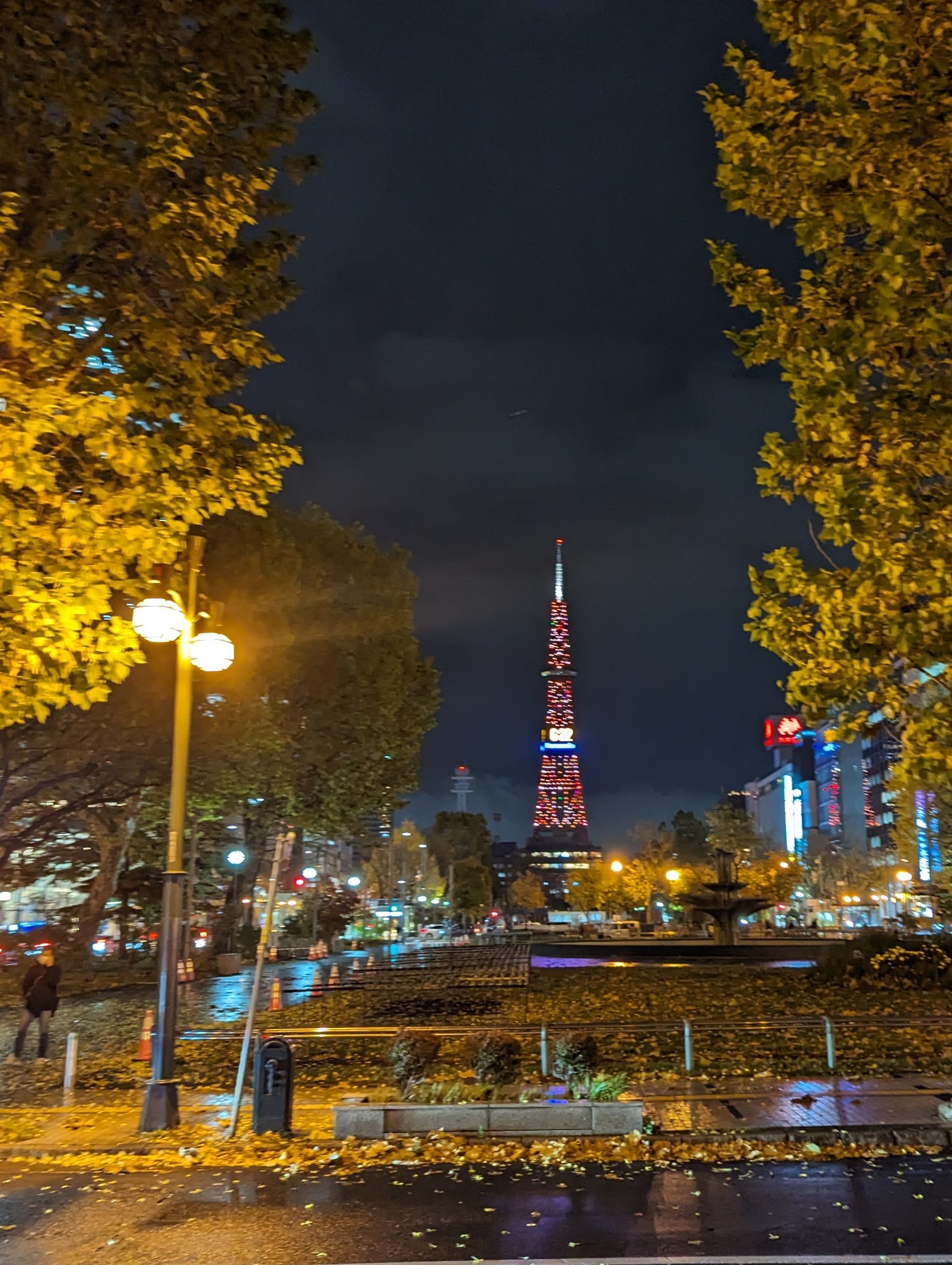
    So, drum roll please (as if the outcome wasn’t already blindingly obvious), I have decided to stay in Sapporo for Christmas and the new year. I will be sad beyond belief for the duration, and I may shed a wee tear in the morning at being away from home, and I will miss my friends, who, despite my lengthy absence perhaps suggesting otherwise, I love unequivocally and beyond measure. 

    Fortunately, Christmas isn’t much of a family affair over here. It’s more of a ‘date night’ kind of event, which means all the lonely folk head to their favourite bar to wash away their solitude and chat into the night until the owner finally yet politely turfs them out into the snow. Who knows, maybe in the next few weeks I’ll meet some dreamy miracle with which to spend the day. Failing that, and fortunately enough, it just so happens that whiling away the hours with a bevy of strangers over a beverage or three is one of my favourite past times, so it’s win-win really.

    At Christmas play and make good cheer indeed.

    Max
    x

    *It’s an awkward, rarely awarded designation for the people I meet, and one I possibly, like most things, overthink. At what point does one go from ‘acquaintance’ to ‘friend’? In the UK, it’s fairly cut and dry and it’s a system I’m well familiar with. Have you exchanged contact details? Have you spoken at length about various topics of genuine interest? Do you meet up from time to time for shenanigans? Yes? Done. There are slightly more challenging ‘rules’ of engagement here (quelle surprise!) For one, people don’t generally do socialising at home. Socialising is mostly done in public places; bars, restaurants and the like. This works out well for me in some respects, as I can plonk myself right in the midst of the fun and games. But this also means that you miss out on that most sacred of all bonding sites; the kitchen at a house party at 3am. Many, if not most, of my longest lasting friendships have been consecrated in the hours after kicking-out time, in a house the location of which I wasn’t quite sure of at the time. Another layer of complexity being the ‘zones’ of closeness. You have yourself (at least I hope you do) then, in ever expanding and ever more distant circles, you have your family, then your close friends, then your colleagues, then the rest of the world. A pretty familiar setup across the globe, however here there is a level of ingrained inflexibility when it comes to bending the rules here. Add to this the inherent difficulty in conducting this intricate, merry dance in bloody Japanese and, well, you can see why I might be prone to ponderin’.


  • Live Music in Sapporo

    Jul 4th, 2023

    Live Music in Sapporo – 7 of the Best Underground, Alternative Venues for Rock, Metal, Pop, Punk, Funk and More

    Visiting Hokkaido? In the mood for some great live music? With so many great gig venues, we guarantee there’s something Sapporo that you will love.

    Sapporo. The capital of Japan’s northernmost island, Hokkaido. Famous for its February Snow Festival and winter sports season, its music scene is often overlooked. As a matter of fact, even some lifelong residents of Sapporo are unaware of the quality and quantity of great music on offer here.

    So, if you are planning a holiday, studying, working, or even if you have lived in Sapporo for your whole life, this guide will take you through some of the best ‘live house’ (ライブハウス – ‘raibu-hausu’) spots in Sapporo. Read on to learn where to find them, what to expect and how to find upcoming events via social media. As always, let us know if you think there’s anything missing, or if you’d like to know more.

    Things to know before you go

    It’s important to realize that very little English is spoken in Sapporo. As a result, it’s best to assume that wherever you go, the level will be near-zero. This means that having some basic Japanese at your disposal, like being able to order drinks, say please and thank you, introduce yourself and say where you are from will go a long way.

    Of course, languages aren’t for everyone, and Japanese is far from the easiest. However, the people of Sapporo are friendly and super chilled, especially in the music scene, so don’t let any communication challenges put you off catching some great live music.

    I highly recommend installing ‘DeepL Translate‘ for any visit to Japan. It’s by far the most accurate translation tool I’ve ever used. If you keep your sentences short and simple, you’ll rarely go wrong.

    Keep up to date

    Live music in Sapporo can be much harder to find, or at least easier to miss, than you might be used to elsewhere. Websites are often out of date. Additionally, there’s no real coverage of the underground scene from websites such as Bandsintown or Songkick at the moment. As a result, keeping a constant eye out on social media, especially Twitter and Instagram, will help you keep track of all the best live music in Sapporo. It also worth checking every flyer and poster you see in the wild. Most will have locations and dates (in Year/Month/Day or Month/Day order) printed in English. Use DeepL to scan the image and translate the text if not.

    1- Sound Crue

    Instagram
    Twitter

    A long-time favourite within the scene, Sound Crue is a must-visit for anyone interested in great live music. Friendly people, affordable drinks and, at the time of going to press, a pizza menu too.
    The live space is big for Sapporo. It has a high stage meaning visibility is good and the sound quality is excellent. Many local bands play here but it also hosts guests from around the country. Conveniently located a few streets away from the iconic TV Tower and central train station, this spot is one of the best in the city.
    Website: SOUND CRUE web
    Address: 〒060-0041 Hokkaido, Sapporo, Chuo Ward, Odorihigashi, 2 Chome−15−1-2 SOUND CRUE

    2 – Pigsty

    Instagram
    Twitter

    Slightly further away but definitely worth the journey, Pigsty (pronounced ‘pig-stee’ by locals) is a slightly more DIY Sapporo haunt. It’s a 20 minute walk from JR Shiroishi Station, so it’s still convenient, and its remote location allows the owners to crank up the volume.
    Pigsty is the go-to spot for anyone who likes their music hard, fast and noisy. The drinks are cheap and there’s a Seven Eleven opposite if you get hungry or need a pick-me-up caffeine hit. It’s raw, grungy and wild.
    It has a high stage for good visibility and excellent sound quality at a decent volume. This spot is highly recommended for a wild night out.
    Website: Pigsty
    Address: 〒003-0027 Hokkaido, Sapporo, Shiroishi Ward, Hondori, 3 Kita−1−5 第一大岡ビル

    3 – Sound Lab Mole

    Instagram
    Twitter

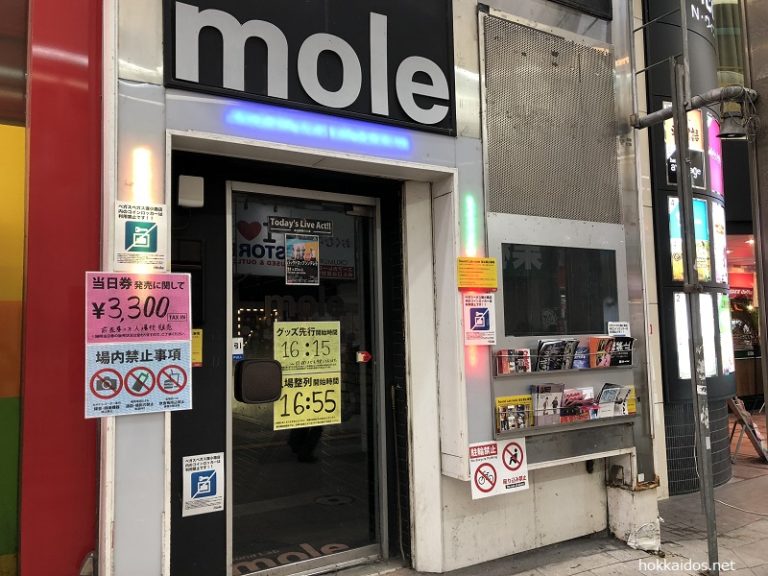
    Located on Tanuki Koji, Sapporo’s covered shopping street, Sound Lab Mole is another excellent city centre venue. The live space is big, with plenty of standing room and limited but comfortable seating. The stage is high allowing for good visibility and the sound is excellent.
    There is a very small smoking room hidden away behind the stairwell, meaning it’s a perfect venue for anyone who dislikes the smell of tobacco. There are also many coin lockers in which to stash your newly purchased merch during the show.
    They host local and guest bands most nights of the week, so you shouldn’t have trouble finding something worth seeing. With such a diverse range of music on offer, it’s worth keeping an eye on their listings any time you’re in Sapporo.
    Website: Sound lab mole (mole-sapporo.jp)
    Address: 2 Chome-14 Minami 3 Jonishi, Chuo Ward, Sapporo, Hokkaido 060-0063

    4 – 161倉庫 (Hyaku Roku-ju Ichi Souko)

    Instagram
    Twitter

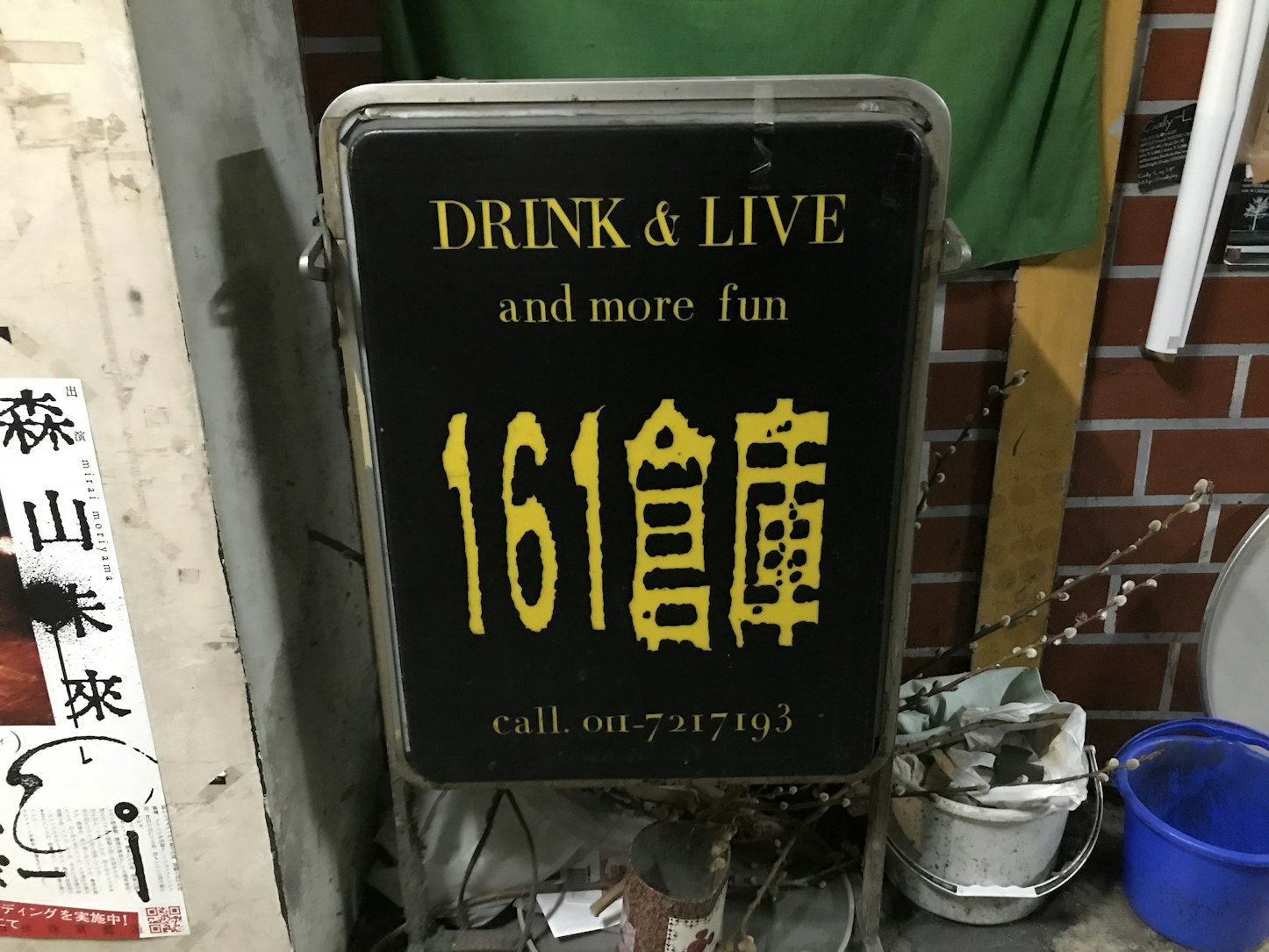
    Next up is 161倉庫 (161-Souko), a much smaller space located near Kitajuhachijo Station, two stops north of Sapporo’s main station. This is another excellent grassroots venue that hosts a wide variety of bands ranging from catchy and uplifting to noisy and wild. It is located on the building’s basement floor and has a cozy izakaya opposite with affordable drinks and delicious food.
    The room is small and the stage is low, giving it an intimate, raw feel. The sound is great and, because of the size of the room, it’s loud as well.
    Website: 161倉庫 Web Station (161souko.netlify.app)
    Address: 〒065-0016 Hokkaido, Sapporo, Higashi Ward, Kita 16 Johigashi, 1 Chome−2−10 西沢ビル B1F

    5 – Revolver Maruyama / Revolver 909

    Instagram
    Twitter

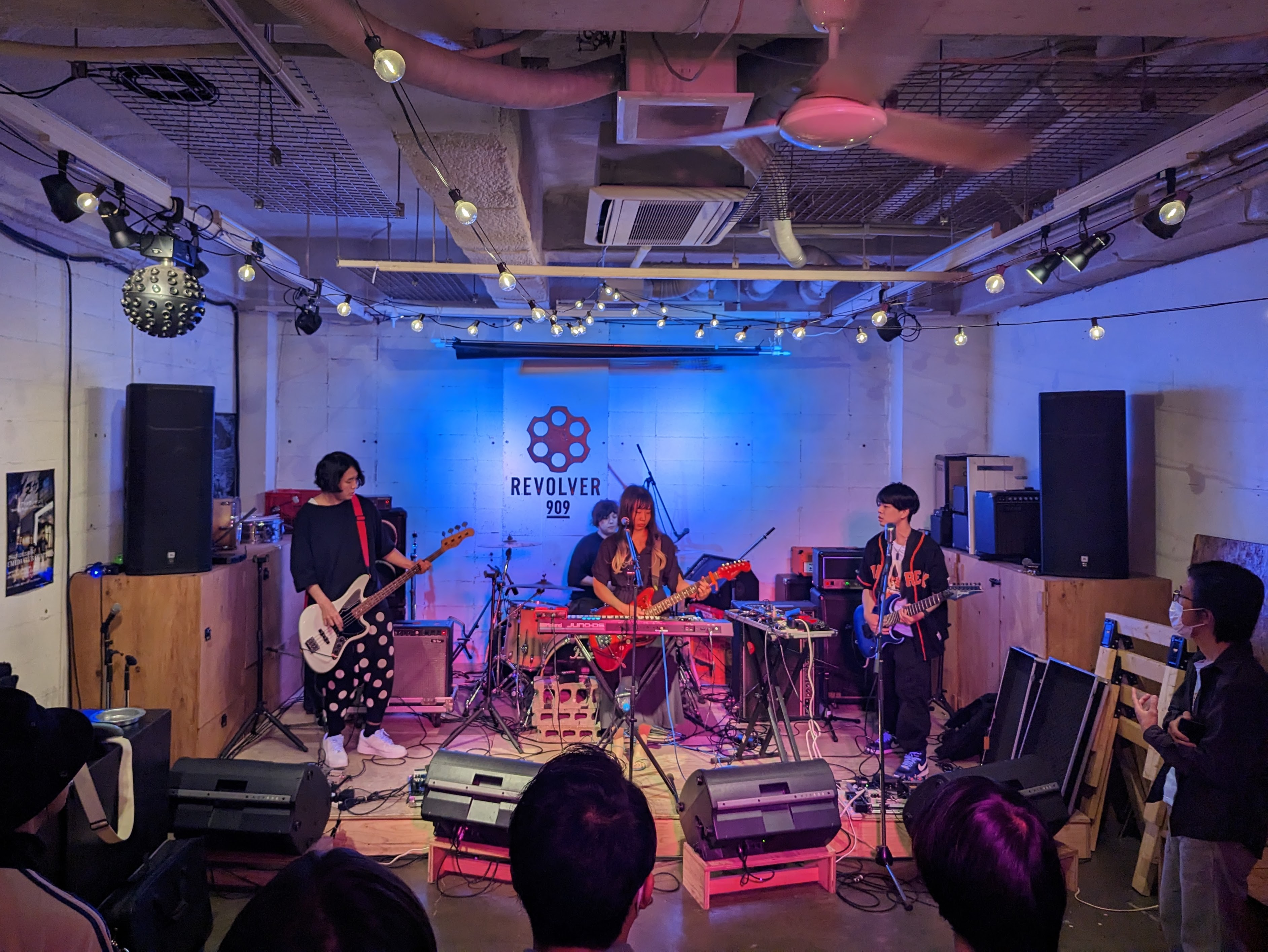
    A great little spot near the beautiful Hokkaido Jingu/Maruyama Park area. An intimate live room, it hosts most of Sapporo’s underground bands at some point over the year. Next door, you’ll find a great bar with an incredible whisky selection and a bar snack menu. Smoking is allowed at designated spots inside, so it’s perfect for anyone who enjoys a cigarette with their drink.
    A little further out of the way than some of the other spots, it’s well worth exploring Maruyama Park and the local area before the show starts to see another part of this incredible city.
    Website: Revolver – Maruyama & 909
    Address: 〒064-0801 Hokkaido, Sapporo, Chuo Ward, Minami 1 Jonishi, 24 Chome−1−8 エスターアベニュー B1F ビル

    6 – Sutajio Shi-rakansu – スタジオシーラカンス (Studio Coelecanth)

    Instagram
    Twitter

    A musical paradise 1 minute away from Susukino Station, it is first and foremost a highly affordable and well-stocked rehearsal studio. DW and Gretsch drumkits, Marshall guitar amps and cabs, Hartke bass amps and cabs, Ampeg, Fender, a huge collection of Strymon pedals… it’s heaven for gearheads. And, at ¥480 per person per hour for non-members, it’s a highly recommended spot if you fancy making noise in between sightseeing days and izakaya nights.
    They also host shows in one of the larger rehearsal rooms. Purpose built for volume, events here are loud and have a true DIY feel. There’s no bar area, so bands will usually bring a cooler full of drinks, or there’s a Family Mart a 1-minute walk away.
    Website: Sutajio Shi-rakansu – スタジオシーラカンス
    Address: 〒060-0063 Hokkaido, Sapporo, Chuo Ward, Minami 3 Jonishi, 3 Chome−3−2 第2 タムラビル B1F

    7 – Klub Counter Action

    Instagram
    Twitter

    A favourite in Sapporo, the venue hosts legendary bands such as tricot as well as local acts. They have a well-stocked bar with a range of craft beers, consistently updated social media pages and a constant stream of great alternative bands coming through.
    Centrally located in Susukino, just south of Tanuki Koji, it’s a perfect venue for visitors who want something loud and wild from their weekend!
    Website: Klub Counter Action
    Address: 〒060-0063 Hokkaido, Sapporo, Chuo Ward, Minami 3 Jonishi, 2 Chome−3 WALL HALL 1階

    There you have it, seven recommendations for a great night of music in Sapporo. Up next is a guide to Sapporo’s underground club scene, so be sure to subscribe for more updates.

    Have any recommendations that we missed? Want to add more to any of the listings? Want to meet up for a beer and a dance? Get in touch and let us know!

  • Together, Alone, Pour Out Your Soul and Wander Home

    Apr 19th, 2025
    • Sapporo at f*ck o’clock in the morning. Beautiful and terrifying in equal measure.

    21:30. The countdown begins.
    One hundred minutes, all you can drink, a meagre ¥3,000 (around £15.50), a steal. Conversational Japanese lessons online average around ¥4,000, so through misguided mathematics this all makes sense to me. Sit at the counter that seats only six, and see where the sweet night sends you. Imperfect strangers brought together by little more than unquenchable thirst. A band of boozehounds who, for 100 minutes, will drink together and be the best of buddies. It’s Friday night, I’ve some sadness in my soul, and sometimes it’s better to be where nobody knows your name.


    Midway down a plywood alleyway packed with slender, intimate bars and restaurants on the second floor of a grey, faceless five-story building much like any other in Sapporo you can find this temple to tequila, this altar to Asahi Super Dry, this church of cheap kicks and cheer. At the basement level is a train station and, earlier in the day, by some dumb luck and lack of direction, I stumbled upon this alleyway whilst confusedly clambering stairs and aiming for the ever-elusive exit. At that early hour none of the places were open save for one; a tiny coffee shop, the outside draped in baseball posters. Through a yellowing glass window I saw two elderly men watching the teams pitch and thwack and dash and catch on a static-flecked CRT screen, coffee steaming and ashtrays piled high with butts, a woman in pale makeup standing beside them perusing yesterday’s results in a broadsheet newspaper dense with indecipherable text. A slim window into a world that will soon be washed away with time.

    The densely-packed, informal, intimate comfort of the places in this alleyway looked too good to miss. It felt much like the backstreet drinking dens a friend in Osaka introduced me to in 2022. A slice of history; the grubby underbelly of cities often idealised by the uninitiated as peaceful, pristine, all hushed respectful tones and stifling social codes. Certainly true for the most part, there are seemingly impenetrable codes written into every interaction and situation in Japan, but dare to dig a little deeper and you will be welcomed with rowdy roaring, clinking cups, ruddy red grins and stumbling steps to piss-bespeckled toilet stalls. It never quite reaches the deplorable depths of a coked-up scrap and a Stella glass to the chin in the car park of the Pig and Giblet on a Friday night, but let’s leave the homesick nostalgia for another time.

    On returning to the alleyway at 8pm, I found all my dreams made flesh. Well, plywood. The bars were all packed and humming, with restaurants ranging from cheap grilled meat skewers and noodle soups to luxury steaks and seafood to soak up the drink. I started in a vinyl bar tucked in a tidy little corner at the end. Dim orange lights and antique table lamps, coffee and tobacco infusing the warm air, every corner, every shelf stacked with a lifetime’s ornaments and trinkets. The master and a solitary punter engaged in conversation. I perused the handwritten menu and ordered a beer. My confidence was shaky and so I sipped and steeled myself. A record player span sixties jazz until it came to a crackling, gentle halt and the master swiftly swept off to flip sides. I eventually slid into the conversation and, glass by glass, my confidence mysteriously grew. A familiar spiel, the ‘jikoshoukai’, or personal introduction, a well-rehearsed bit of patter. It went splendidly and so I felt very big and very clever.

    Ego bolstered and confidence soaring, I eventually left in search of something new.


    21:32. Highballs and high spirits.

    98 minutes left to go and I sit with three men each in their early-thirties.
    Kou likes 90s UK R&B. He is handsome, sporting a pristine white hoodie and a jauntily angled baseball cap. He has a manic energy I find electrifying. He leaps from person to person, topic to topic, exuding youth and confidence.
    Aki sells cars. He is quieter, gentler. I tell him of my plans to move to Sapporo in the future and he promises me a good deal on a hatchback large enough for a drum kit but small enough for the narrow city backstreets.
    Riki is large and muscular. He sits on the furthest stool and doesn’t say much but he has a remarkable warmth. When he smiles, he smiles entirely.

    Ku-chan pours the drinks tonight. She is sweet, welcoming, and curious about me as not many Westerners find their way to this part of the city. She loves action movies, hip-hop, an tiny and adorable species of bird called the ‘snow fairy’, and Family Mart fried chicken at midnight. There’s an enchanting and rare magic to her eyes. I could stare into those eyes forever. All cool charm and charisma and devastating beauty. I fear I am letting myself in for a world of hurt as we talk, but I give myself over gladly because I am a fool, and who am I to question this heart that beats regardless?

    The clock tocks on and conversation turns to partners, wives and pasts. Aki is married, Kou is single and steadfast in remaining so and Riki keeps his cards close to his broad chest. Ku-chan says she likes Western men. Macho men. Those men that are a fine mix of muscle and magnetism. I regret not doing more press-ups. I mourn my lack of magnetism. I nonchalantly suggest that maybe an anxious, stick-thin, six-foot frame and a short-trimmed beard might be masculine enough.

    It would not.

    Their Japanese is swift and casual and it’s hard to keep up. Riki wears a bandage on his nose. He is warm and funny and has the vague air of a boxer, but I worry he may be a hoodlum. I would prefer not to be pummelled into a fine paste tonight, so I ask casually if the bandage is from some violent incident. He laughs. “No! I snore at night. The strip helps open my airways!” and he inhales with a snort. It makes no sense to me but in keeping with politeness I smile and nod and say, “Ahh, I see!”

    Time slips away as smoke curls in blue clouds beneath soft orange lights. Ice tinkles as tumblers are drained and filled again. J-pop bounces around the room—pristine melodies swirling through the tobacco-polluted air. We four punters float, carefree clouds briefly mingling in the ink black sky, before the wind carries us away into the night.

    These places are a welcome distraction for a lost soul like me. In so many places just like this I have been welcomed into a new world and treated kindly, with tremendous generosity. Some small connection, a fleeting moment shared. I can open my heart and share my soul and these temporary friends will sit and listen. One reason I love it so much here is how deep conversation can go in a short space of time. These people I have known for barely an hour and yet we open our hearts, pour out our souls and listen and nod in quiet understanding. I hold deep gratitude for those I have met here and in other places much like this, gratitude for their warmth, their kindness and their sharp but tender humour.

    It’s eleven o’clock, and the jig is almost up. Tomorrow’s tasks tug us apart as time ticks on. We thank each other for the night, gather our belongings. We bow and thank Ku-chan for her kindness and service. We bow and thank each other for the time we shared. We exchange social media details knowing we may never talk again and then we each walk home alone, routes split in every direction, grateful for 100 minutes of life, 100 minutes that briefly burned with hope.

    Maybe one day that 100 minutes will stretch into a lifetime. Maybe one day there will be a Ku-chan that sits not opposite, but beside me.
    The right time.
    The right place.
    The right person.
    And these bars will lose their appeal.

    Any time now…

    23:13. The countdown begins.

  • “Write.” – 02/04/25

    Apr 3rd, 2025
    • Ninh Binh, Vietnam

    Write. For the love of all that is just… Just write. Pen to paper, fingers to keys, rattle and scratch and let it all out. This is my new mantra, speak it slowly, speak it over, mumbling memoranda as I limp sullenly, petulant and pitiful, into my fourth decade on this accursed Earth.

    Sapporo
    Wednesday April 2nd, 2025
    14:40

    I am sitting at a 20cm high table on a ‘sofa’ made of a ‘mattress’ that can fold into a sofa shape. It is an unconvincing object that operates neither as a convincing sofa, nor as a convincing mattress. As I sit, I write. I tap away at clattering keys, hunched in an uncomfortable cross-legged position, surrounded by filled up notepads, unread comics and the neglected textbooks reminding me of my much-maligned study regime. My eyelids wilt, lowering, then lowering more, the lunch of fried fish, pickles and a ‘nikuman’ (meat bun) that was almost entirely ‘man’ with very little ‘niku’ is pulling me slumberwards. I am firmly in the ‘napping’ epoch of life now and it is one of the few aspects of these ever-advancing years that I actually cherish.

    From the ninth floor window of my rented apartment, the snowcapped ridges of Mount Moiwa dominate the view, a layer of ice and snow covered in the brown bristles of skeletal winter trees. Between two of the peaks, at around 6pm on a clear day, I can see the sun set, casting deep pinks and vibrant ambers into the blue sky. This magnificent landscape is criss-crossed and partially blotted out by great grey buildings and the persistently buzzing motorways that run parallel to the teeming expanse of the Toyohira river. Grey scars accumulate here, all the beauty blotted out in time.

    Today, there will be no sunset. Not a visible sunset at least. The sky is overcast, although not with the grim, soul-depleting grey I associate with England, but with a sharp whiteness, a blanket of ice and snow hanging heavily, yet still not quite ready to fall.

    It has been two long and eventful years since I brought my regular travel contributions to an end. I lost sight of the ‘why’, as I did with so many other hobbies. I know I have grown lazy, too content to idly drool into a screen at the infinite stream of memes, endlessly squeezing that moreish dopamine milk from the pert neural teat. Fear got the better of me, perhaps. Errors in syntax, inaccurate facts or simply too much ‘Max’, overly frank, (“No one wants that,”) so I held him back. But time is relentless and unforgiving, and some things that are lost can never be brought back.

    I flick through notebooks, looking for some past scrawl to toss into the pit. To do lists and timetables, calculations and memoranda. Every scribble practical, pragmatic and pedestrian until two coffee stained pages catch my attention.

    Ninh Binh, Vietnam, April 2nd, 2024.

    “Sunburnt skin, pock-marked tarmac, the rhythmic squeak of the spokes of slowly spinning wheels. Sweat drips unnoticed from the nape of my neck onto my soaked shirt. I want to find somewhere peaceful, where nature still dominates, far from the noise and the dust and the hum of traffic, shaded from the unrelenting heat of the day. I follow the path between vast, green walls of the karst landscape, trundling along this meandering, sun-cracked path, this gouge in the ancient earth.

    “Ninh Binh is an area unlike any other I have been to thus far. This area, this vast and serene landscape transfixed me the moment I first arrived. Vaulting, slender towers of black limestone surge into the sky, topped and teeming with unreachable, isolated forests, the vibrant life tumbling down the sides and pouring into wide, flat rice fields, lakes and rivers below. 

    “The mountains, domes, towers and cones chiefly comprise of limestone gradually eroded over time, with storms, winds and floods weathering them away leaving thousands of standing sentinels keeping watch like aeons-old gods. In time, this whole area will be reduced to a single level plain, beaten and worn, featureless and flat.

    “As I roll along the road, the tarmac turns to stone, turns to mud, turns to not much road at all, just spine-shaking, cartilage-crunching paths rarely ever ridden upon. These are the kinds of paths that take us where we ought to go. Follow this particular path long enough and you will reach an idyllic, enormous lake, surrounded by mountains and trees on all sides. I come to a halt and rest on a decades old concrete wall, now covered in moss and weeds. No main roads go through this wide open area, not yet at least, and so I am free to sit, in this perfect depression carved out from the rest of the world, and to listen to the echoing calls of a thousand creatures I will never know the names of. I take out my notebook and I write.

    “I praise the beauty that abounds, the half-eaten leaves, the sun-baked mud, the peculiar froth at the edge of the water, the nibble of a defensive ant on my ankle, the rank odour of dung on the breeze. It has taken all too long to reach such a haven by bicycle. Not ones to let such splendour go unaltered, the human population is doing its best to assert dominance over this paradise. Ninh Binh and the Trang An area have sadly fallen foul of progress. There are a number of locations in this vicinity that have become popular stops on the tourist trail heading through Vietnam and the locals are understandably keen to capitalise on the success of the earliest hostels, hotels, restaurants and bike rental shops. Construction continues apace, but before anything can be built, what went before must be cleared, cut, broken up and buried. It is a fact of life that places that become popular draws for tourists will inevitably expand to the point where the original draw that made them popular; the wilderness, the natural spectacle, the peace and quiet, the rural beauty, is razed to the ground and replaced by bustling, noisy streets and man-made monoliths, plate glass sentinels stretching tall into the sky. 

    “So, make haste, and go see it whilst you can, before the echoing call of bulldozers becomes the dominant sound of these valleys.”

    I place the notepad on the table and sip my lukewarm coffee. This is the last I will write in my thirties. Onwards and upwards. Progress. Grey scars accumulate.

    Write. It has been almost two years since I was a regular contributor to the world through this minor medium. So here I sit, a mock-writer, mourning mock-aspirations on a mock-sofa, on the eve of a very-much-not-mock-40th birthday, and as I sit I realise that time is of the essence, and it would be cruel, crueler than I would ever want to be, to withhold the fragmented, crude contents of my rapidly desiccating mind from the world. You deserve that much at least, for your sins. So, I plan to release more of my work this year. A lot of it is work I have fretted about and held on to for fear of it being terrible, or unfinished, or derivative, or of little interest to anyone. But, as I clamber up the gnarled oak tree of time, I gleefully accept the cantankerous, contrarian mindset of the older gentleman, he who could could not give a monkeys, and I now plan to swing simian-like through the upper canopy, flinging all of my efforts out into the wilderness, gibbering and hooting with all my heart until the sun sets one final time.

    Write. For the love of all that is just… Just write.

  • Seven Summery Months – A Summary

    Nov 15th, 2023

    It’s mid-November and I’m sitting at the laptop at 8:51am in Sapporo, in Japan’s soon-to-be frozen north. A faint dusting of snow fell yesterday, however the cold, dry air is preferable to the 24 Hour Steam Room/Max as Mosquito Buffet climate of Thailand and Malaysia.

    Japan, England, Malaysia, Thailand… The summer has been long and wonderful this year and I am full of gratitude.

    My first weekend back in Sapporo has just passed and a splendid weekend was had. Loud music, people I’ve missed, late night walking below towers of neon lights and debauchery, the lot. I felt welcomed back into the wintry fold. I do miss home though. As great as this city is, it’s no true replacement for ‘Faaampton.

    Let’s cut to the chase. Why the long wait, Max? Can you quickly sum up the last seven months? Tough question, tough task. I will ascribe the pause to a heady mix of laziness, an inability to focus, a lot of moving from place to place, wasting time on the modern curse that is social media, and generally being Really Quite Busy™. I felt a surge in creativity after my last visit to Sapporo, although this was fleeting and little came of it. In the last few weeks, I’ve been trying to put my finger on what the problem is.

    I have been writing, but mostly diary entries, and most likely never to be finished attempts at short stories. I never feel very happy with what I write. I rewrite, over edit, censor, and generally tear the soul out of the thing until it’s a limp remnant of the original idea. It’s a frustrating habit. ‘First thought, best thought’ as Chogyam Trungpa Rinpoche, then Ginsberg, once opined. It’s a suspiciously terse mantra. I wouldn’t be surprised if it had gone through a few rewrites.

    Another recent realisation has been that without making bad art we never get around to making good art. Holding back on posting anything because I’m concerned it might be a little too honest, or that I may have missed a couple of typos, or that the theme gets lost towards the end, or that it’s a load of old bollox; this gets me nowhere. I doubt anyone would call me a perfectionist, but I certainly spend a lot of time worrying about whether anything I do is ever ‘Good Enough™’. Offering nothing at all is the safer option.
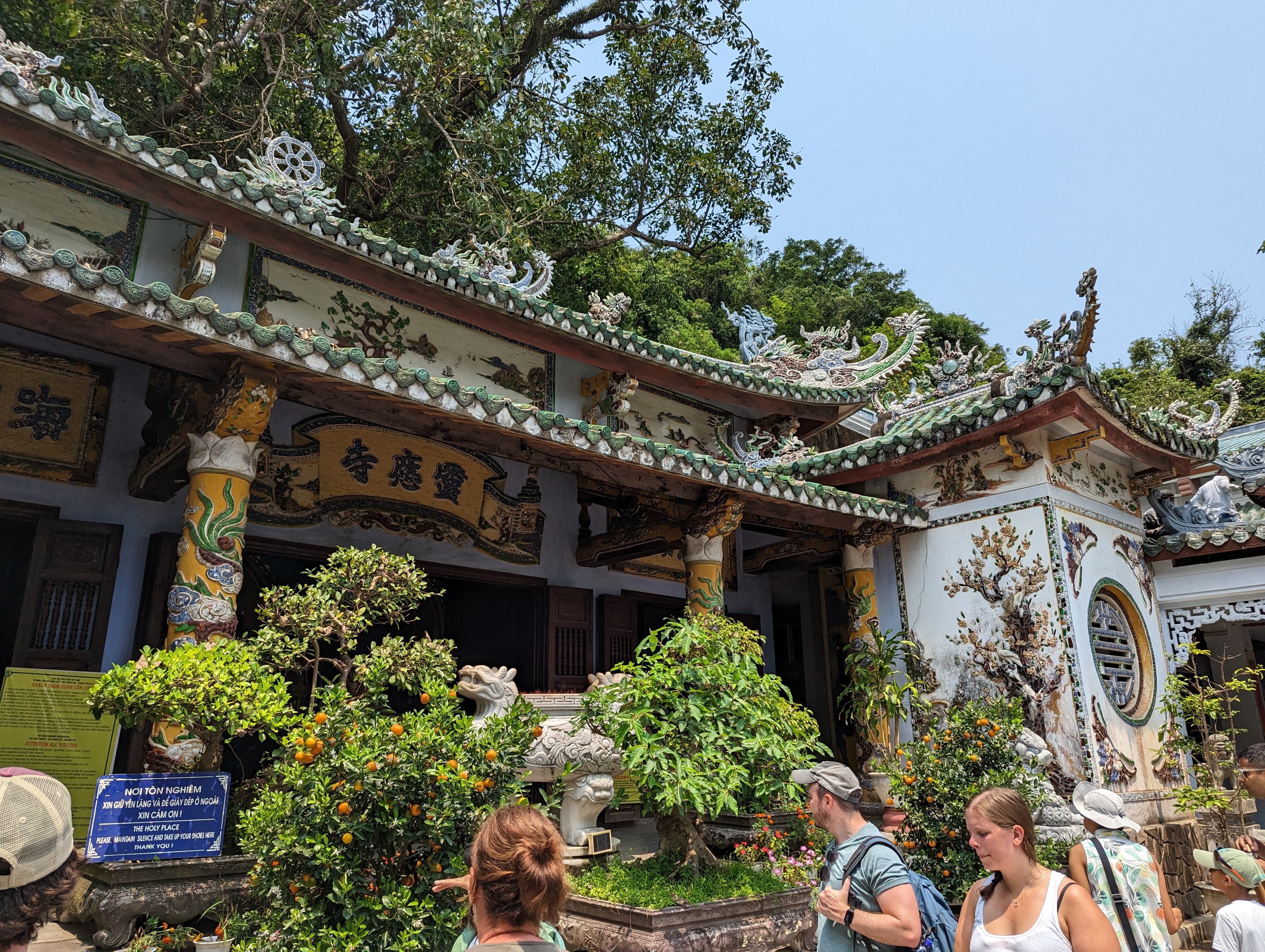
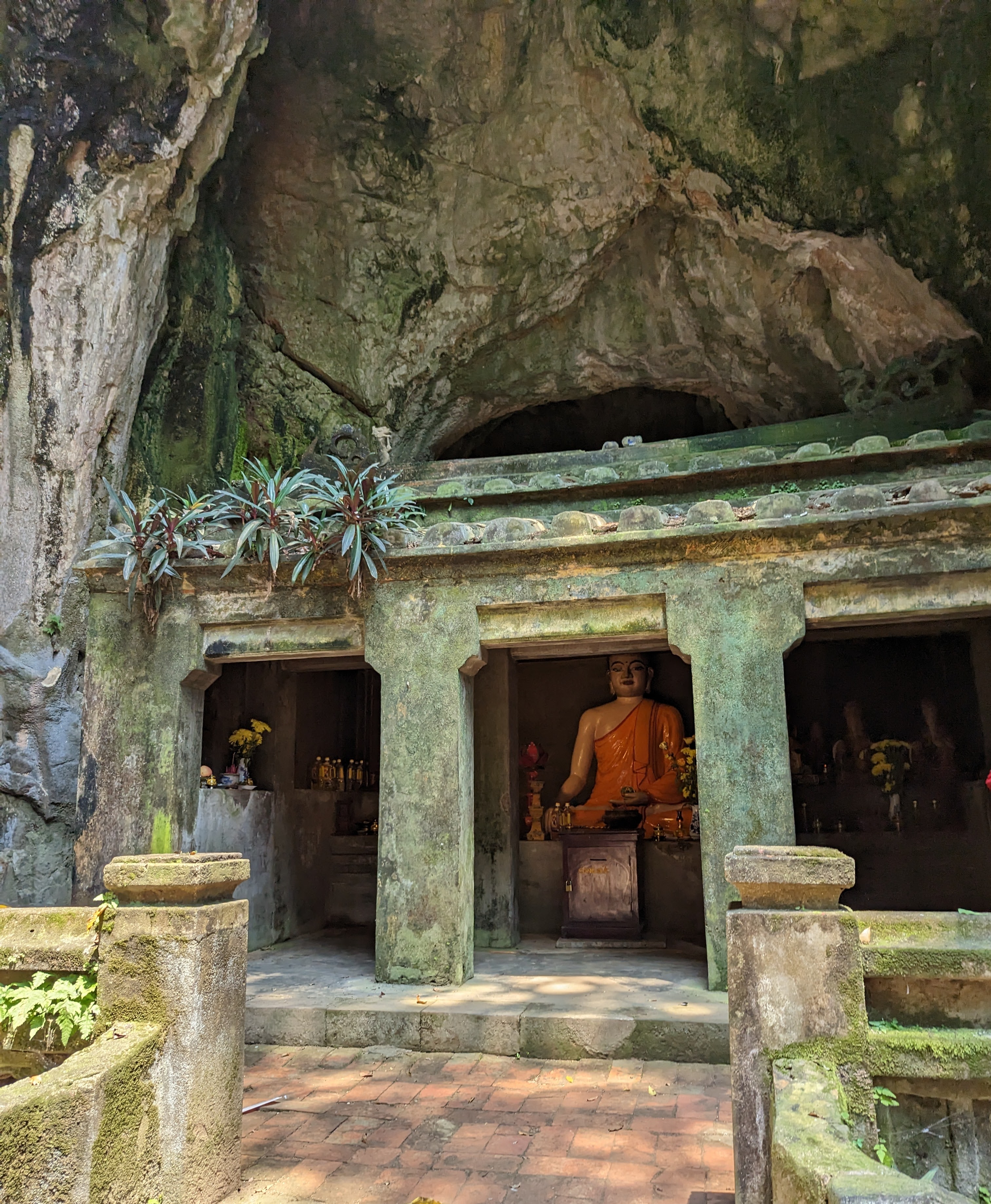
    But, no work is ever perfect, and neither should it be. Well, unless that’s your aim, in which case, edit away. Not for me though. Not any more.

    Better off making something than nothing, eh?

    “Better off making something than nothing.”

    The words roll over the ocean and into the barren night. Moonlight glimmers on the gently rolling waves.

    “Better off making something than nothing!” he roars into the endless black expanse. A pause.

    “Better off making something than nothing,” only this time quieter. Almost a whisper. This time, the words do not echo. The whispers are consumed by the darkness. The lapping of waves grinds to a halt, the soft sand contracts into minute shards of glass. The clear-black sky hazes over. The cold night air swells, growing hot and thick and stifling. A fetid stench permeates the air, a putrid, decaying, chemical-laden smog singes his nostrils and scalds his eyes.

    He finds he is bound fast in a standing position. He tries to step forward, to raise a hand, to shut his eyelids to the heat and haze, any movement at all, even to breathe, but he cannot, held in place by an invisible, irresistible force.

    Panic takes him.

    What is this force that binds him? He tries to scream, but the air in his lungs is solid as stone, weighing him down, tearing and scraping as he desperately attempts even a single, small breath.

    An explosion of brilliant pain and the panic succumbs entirely to a singularity, an infinite mass of unimaginable heat and gravity, deep within his skull. An ashen tendril, coarse, prickly, probing, emerges from his left nostril and searches his cheek, his lips, his jawline, flexing and feeling for purchase. A foul and unidentifiable thing emerging.

    The tendril slithers out inexorably, wrapping itself, pulsating, worming its way around his face, and then around his neck, down across his chest, his groin, further it extends, caressing his calf, seizing his ankle, before sinking into the ground.

    An overwhelming pressure exerts itself upon his body as the tendril digs in, pulling him down, crushing his bones, tearing his ligaments, his flesh splits and spills as the tendril grinds his body into the shards below. The final spasms of electrical impulse fire from his brain to nerves that are no longer connected and the pain, at last, is gone.

    The tendril finishes its work, convulsing, massaging what’s left of the body into the shattered glass of the ground.

    The haze clears, the chemical stench dissipates, the waves’ motion is restored, the glass softens back into sand and the moonlight glimmers again. The air is clear once more.

    The tendril comes to a rest, breathless, and lets out a mournful sigh.

    “Well? Now what?”

    The tendril looks up, huffs, and wilts, now looking rather ashamed of itself.

    “What was the point in that? You know someone’s going to have to clear that up don’t you?” The Voice is stern, authoritative, and deadly serious.

    The tendril slumps, slack and remorseful, shamed by The Voice’s candour.

    “Oh, come now. Chin up.” The Voice is now gentler. The tendril has no chin. “No point moping around all night. He’ll be back in the morning.”

    The tendril looks up, grateful for forgiveness.

    “Leave him alone next time though,” The Voice intones, “Better off leaving something than nothing.”

    “Better off leaving something than nothing,” gargles the tendril, in its own incomprehensible dialect.

    “Indeed.”

    The tendril slowly makes its way into the ocean, the moonlight glimmers on, the soft caress of salt and sea washing away the remnant paste that was once a man.

    Then… blackness.

    Silence.

    Nothing.

    Peace.

    …

    ..

    .

    And that pretty much sums up the last seven months.

    Max x

  • Da Nang 31-03-23- Lady Buddha, Am Phu cave, Marble Mountain, Dragon Bridge Market

    Apr 5th, 2023

    A day of wholesome, shameless tourism.

    After around four hours’ sleep, I wake feeling suprisingly fresh. My upside-down sleep schedule has reverted back to normal and I can now sleep from around 11pm until around 6am. I feel refreshed and productive.

    Breakfast. Instant noodles, mango and strong, black coffee. These particular noodles come quite beaten up in their packet, so I’ve found if you save the little broken bits, mix them with the packet of sprinkles and scatter the mix over the top, the combination of chewy noodles and crunchy fragments elevates the humble dish to an almost Michelin-level standard. The pink stuff is Muối Ớt, a type of chilli salt, which works superbly with fruit. A cardiologist’s nightmare of a breakfast but delicious nonetheless.

    I board a tour bus at 8:30am and we head to Chua Linh Ung. The name means ‘Spirit Responding Temple’, and includes a nine-storey pagoda and a colossal statue of the Lady Buddha, the Bodhisattva Quan Am, aka the goddess who ‘Listens to the cries of the World’. She can be seen from any point along Da Nang’s coast, a pure white monolith amidst the deep green backdrop of the mountainous forest. We’ll meet her shortly.

    The area is impressive to walk around, with its numerous statues of religious and historical figures, beautifully cultivated plants and stone pillars.

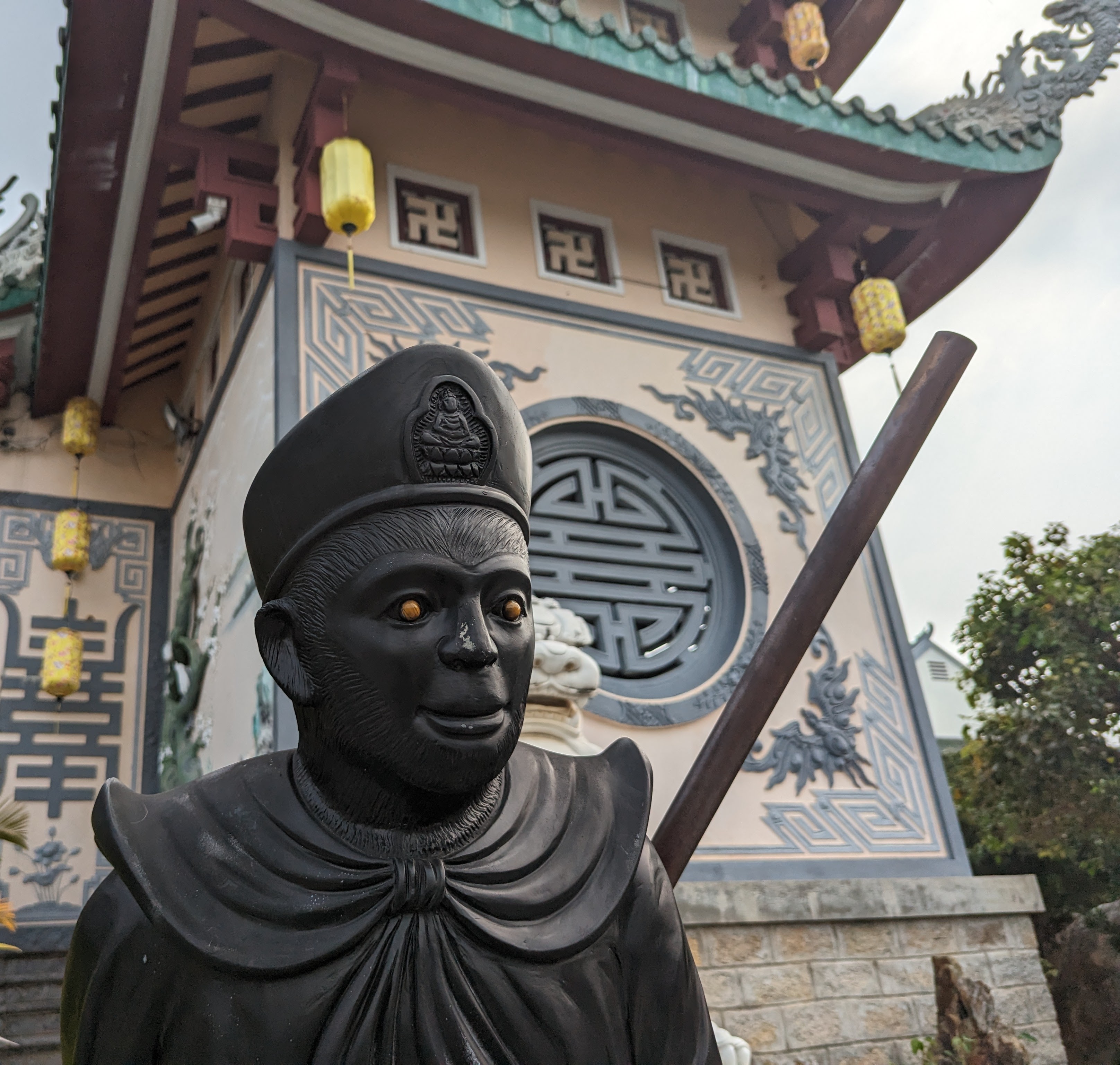
    Almost all of the statues are made of white stone. This is the only one I can recall that was made from black stone. With its golden eyes, wooden staff and unusual expression, it’s a stand-out piece in the temple grounds. Many of the statues are guardians designed to protect the holy sites, granting access only to those who have earned it, sorting the moral wheat from the immoral chaff.

    There she is. 67 metres, according to our tour guide. Positioned high in the mountains overlooking the coast, she oversees the fishing area to the north east of Da Nang city. This is the area where much of the seafood is caught each day. Sadly, as with many traditional industries, fishing is in decline due to the dangerous nature of the work and the rise in more cost-effective overseas imports. The Lady Buddha blesses the fishermen each day with good luck and prosperity and, one hopes, her blessings work, or the fishermen will eventually have to retrain as tour guides.

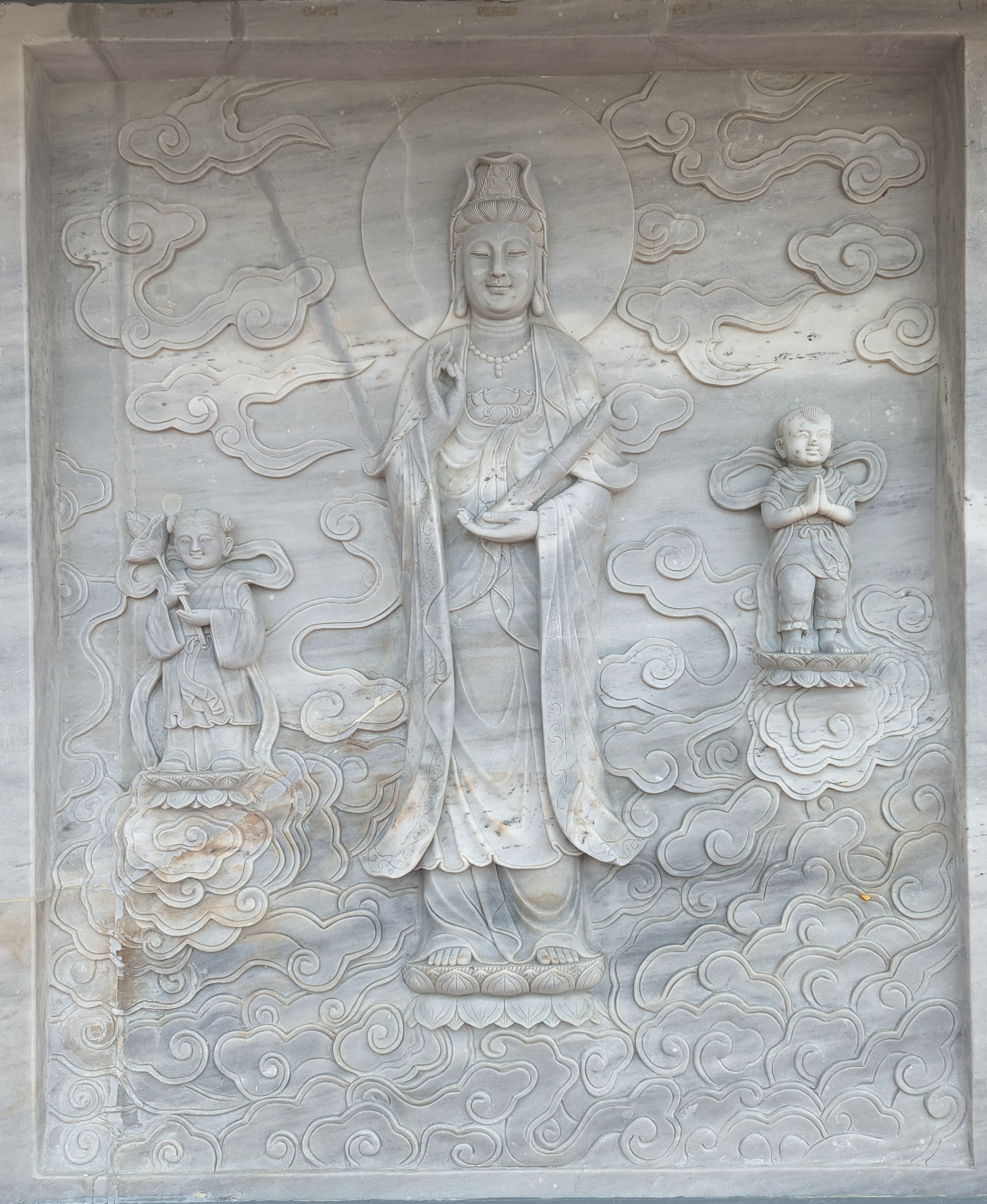
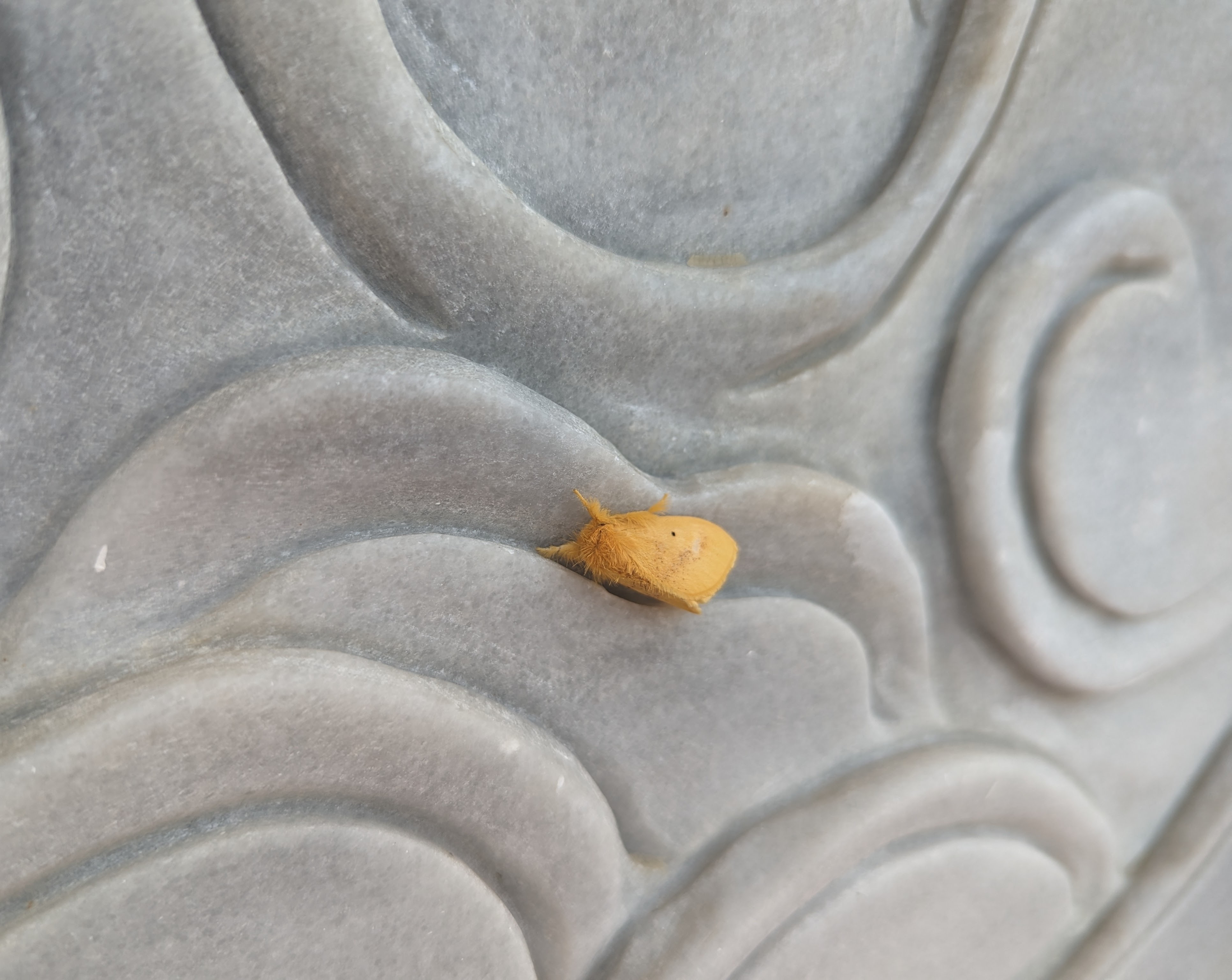
    The marble from Marble Mountain is a constant presence. So much marble has been used on this site alone that I am surprised that there is any mountain left. I later discover that the majority of the marble is now imported from China. I especially like the clouds in this relief. There is a beautiful little moth hiding in the carving too.

    Poor thing. It is roasting hot, full of tourists and barely past 9am. I don’t think it has much chance of making it to dusk.

    After some time wandering around and admiring the sights, we board the bus and head along the coast to Non Nuoc Stone Village, the home of stonecraft in the area.

    • He’s dead… wrapped in plastic…

    The workshop we visit is packed with marble statues. They are impressive in both scale and number. Despite the mass-produced feel, they are fascinating to look at, gods, dragons, scenes from the past as well as abstract, modernist feature pieces. The workshop also has a very large giftshop packed with pocket-sized glass and stone trinkets, which is probably why we spend nearly three quarters of an hour here when fifteen minutes would have been plenty.

    After this, we board the bus once more and head to Marble Mountain and the Am Phu cave.

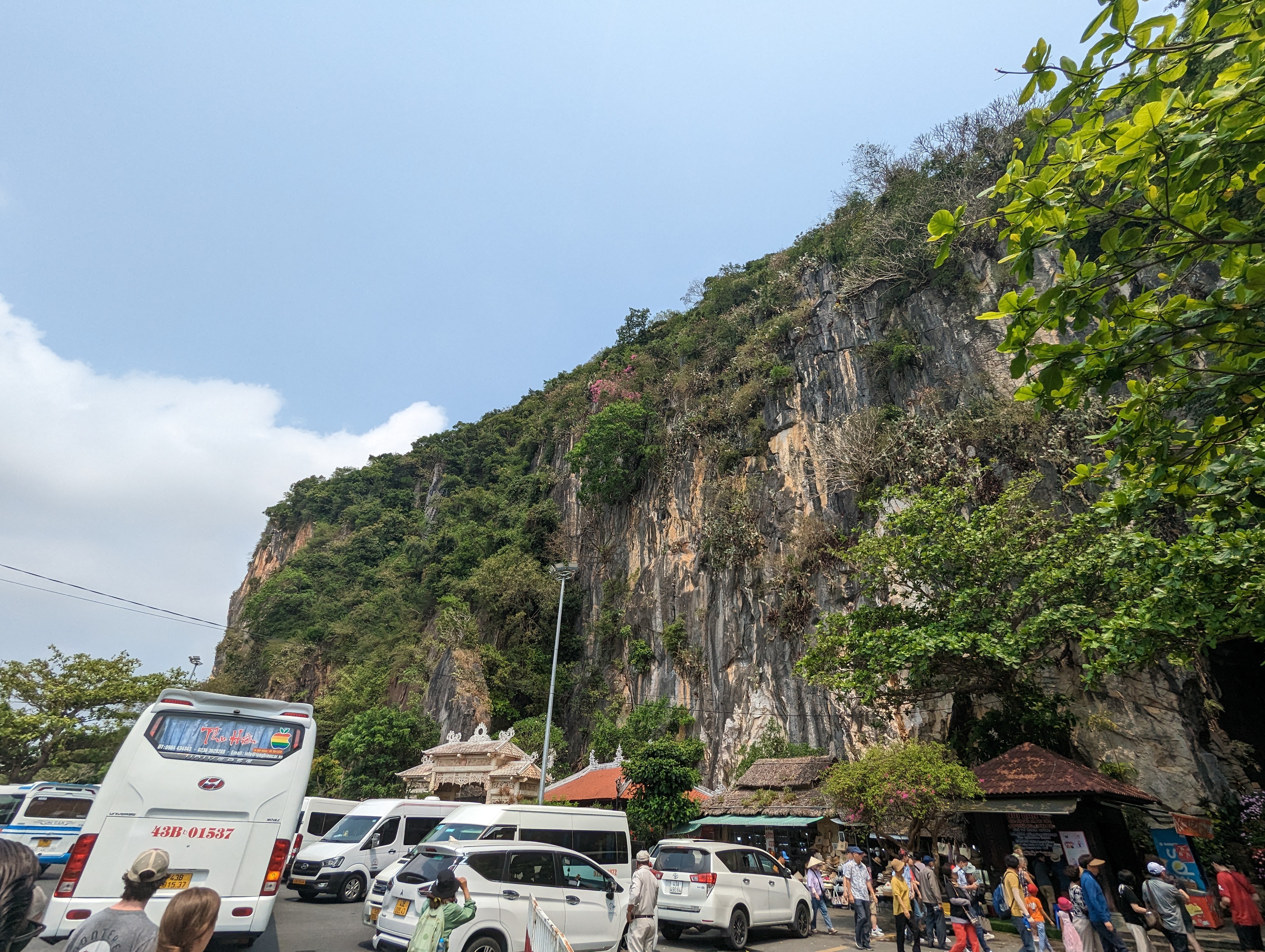
    Marble Mountain from the main entrance.

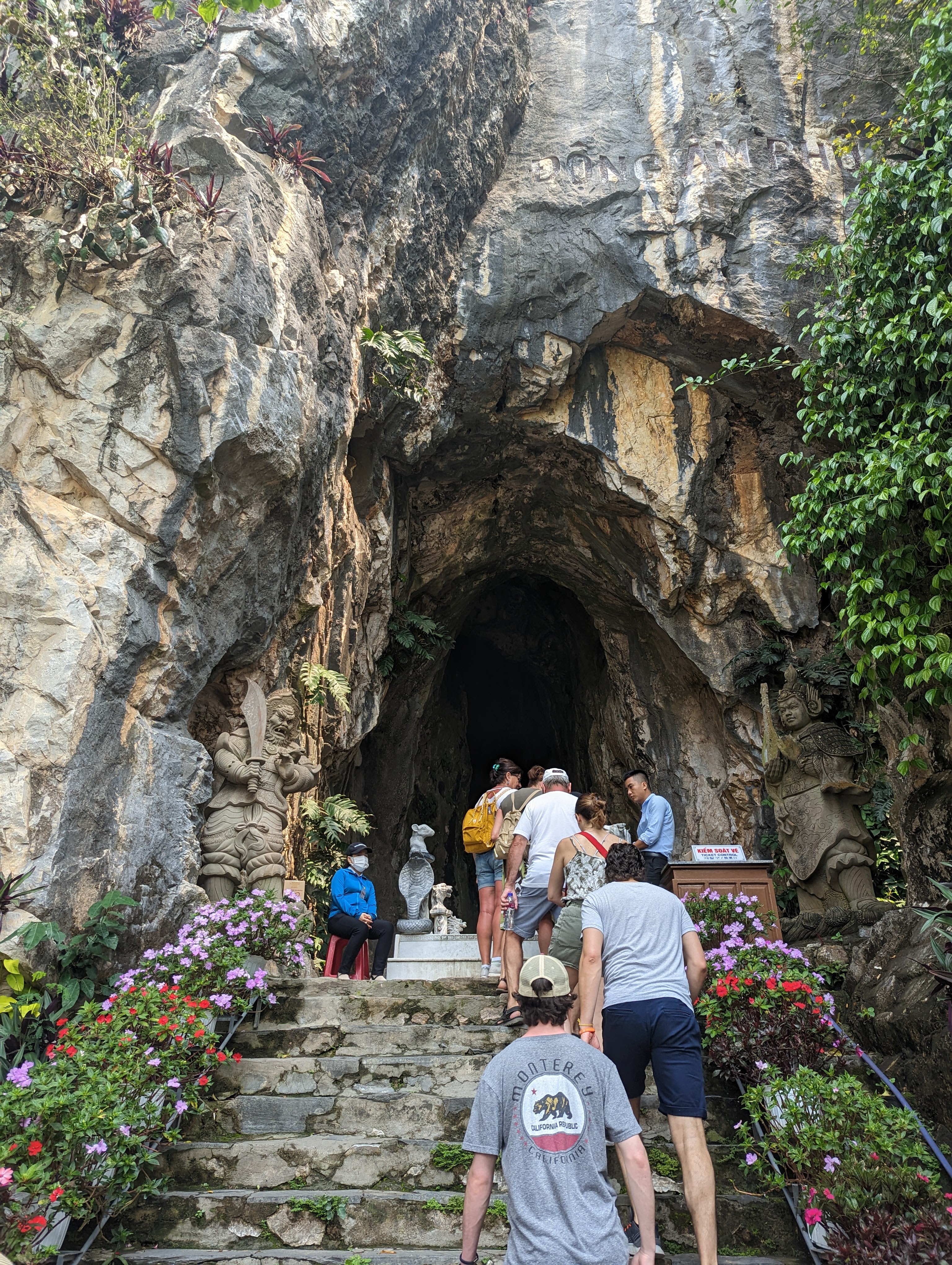
    The entrance to Am Phu cave, at the base of Marble Mountain. At this point I become concerned. Have I wandered (read: hobbled) blindly into a day trip of uneven, slippery, precarious and challenging steps and walkways? Would I have to ‘sit this one out’, and join the elders as they rub their aching joints and nurse ice coffees whilst the others galavant youthfully around us? Not quite. There are a couple of challenging sections but nothing too risky, and one staircase that I politely declined because the steep steps were barely a metre across and packed to the proverbial rafters with the shuffling masses.

    A marble map.

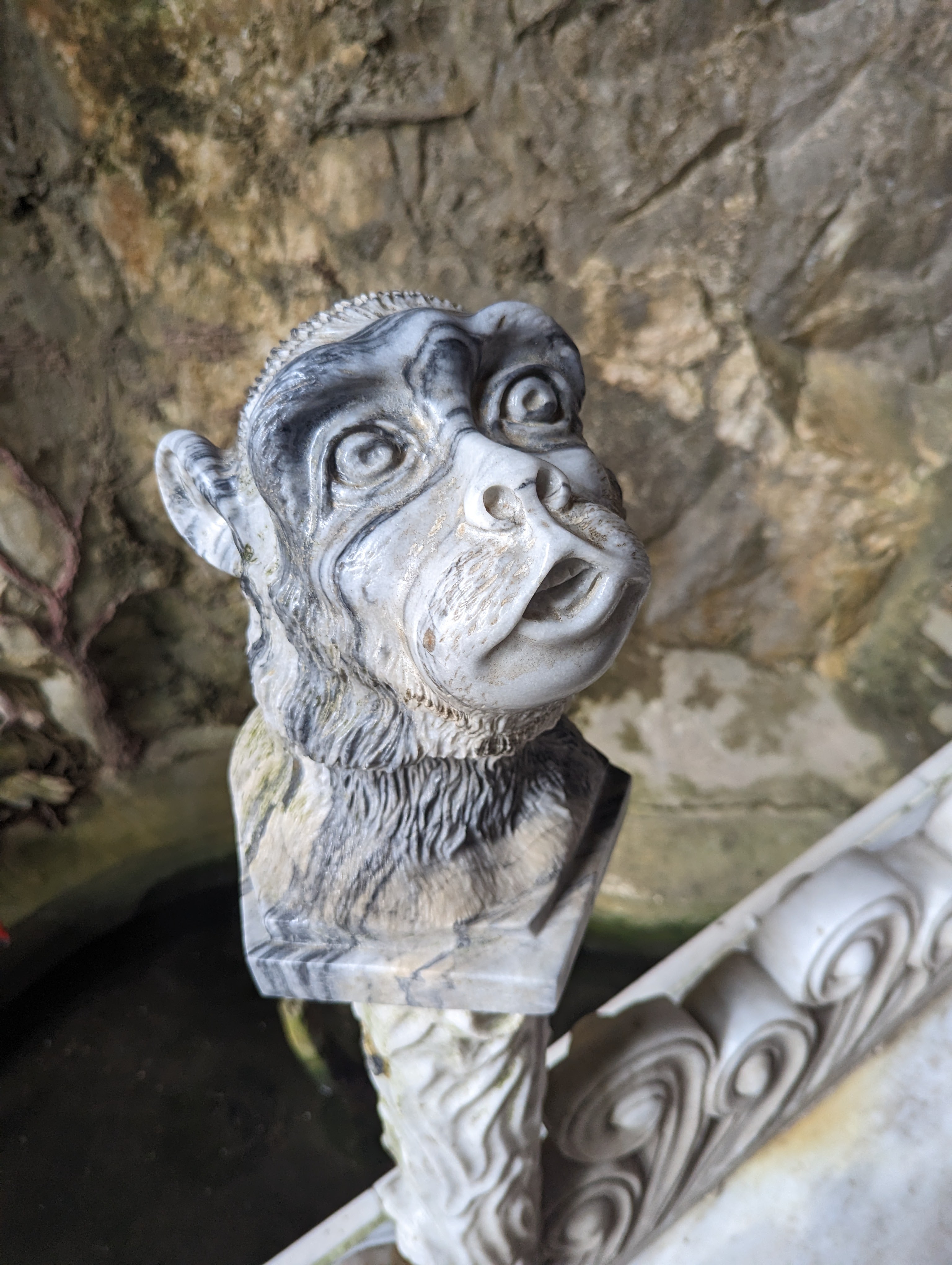
    A marble monkey. On entering, you cross a bridge lined with statues of the Chinese zodiac animals. The bridge represents the crossing from the mortal world into the afterlife. Rich with detail, it’s an impressive start to the visit.

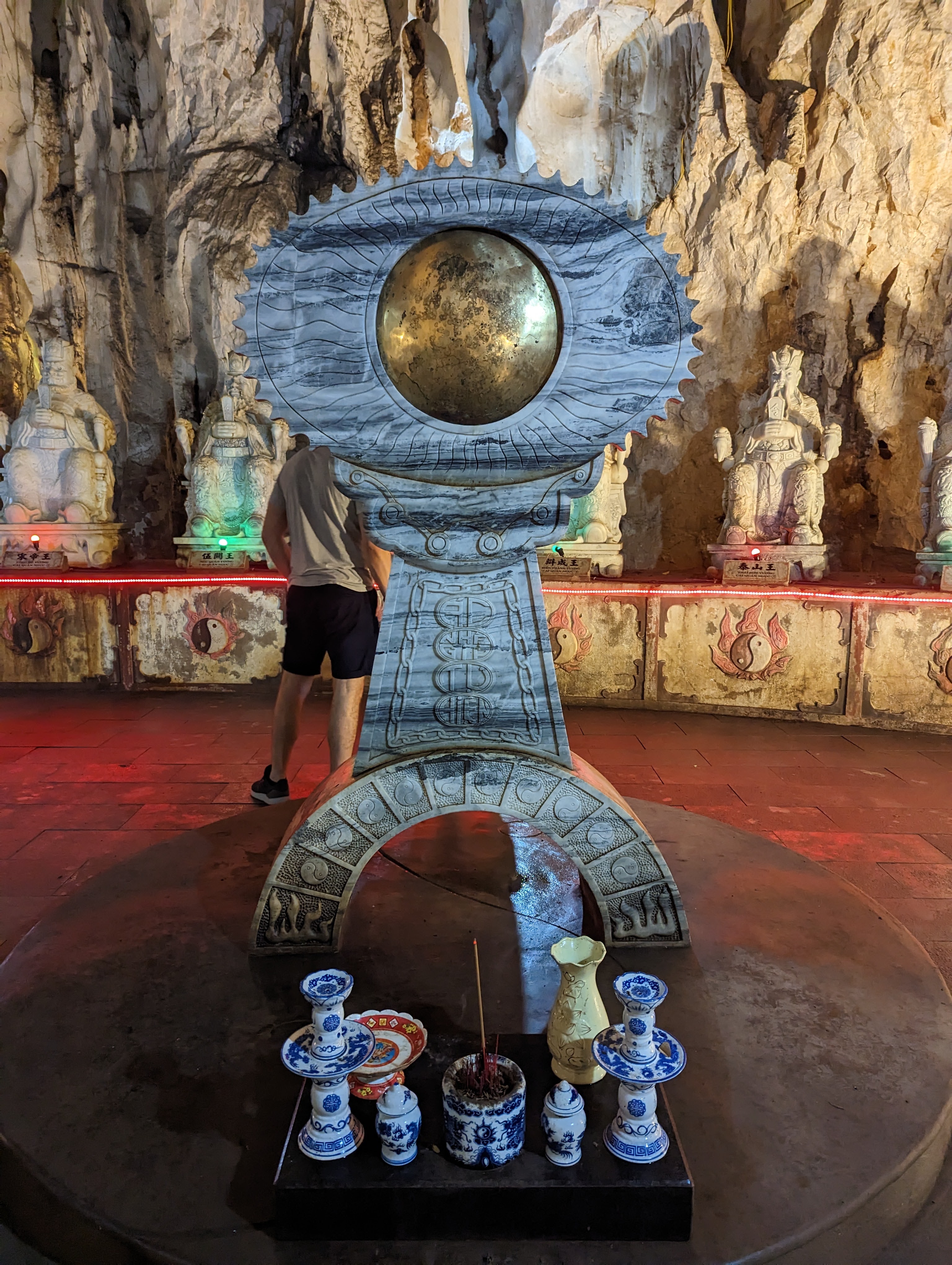
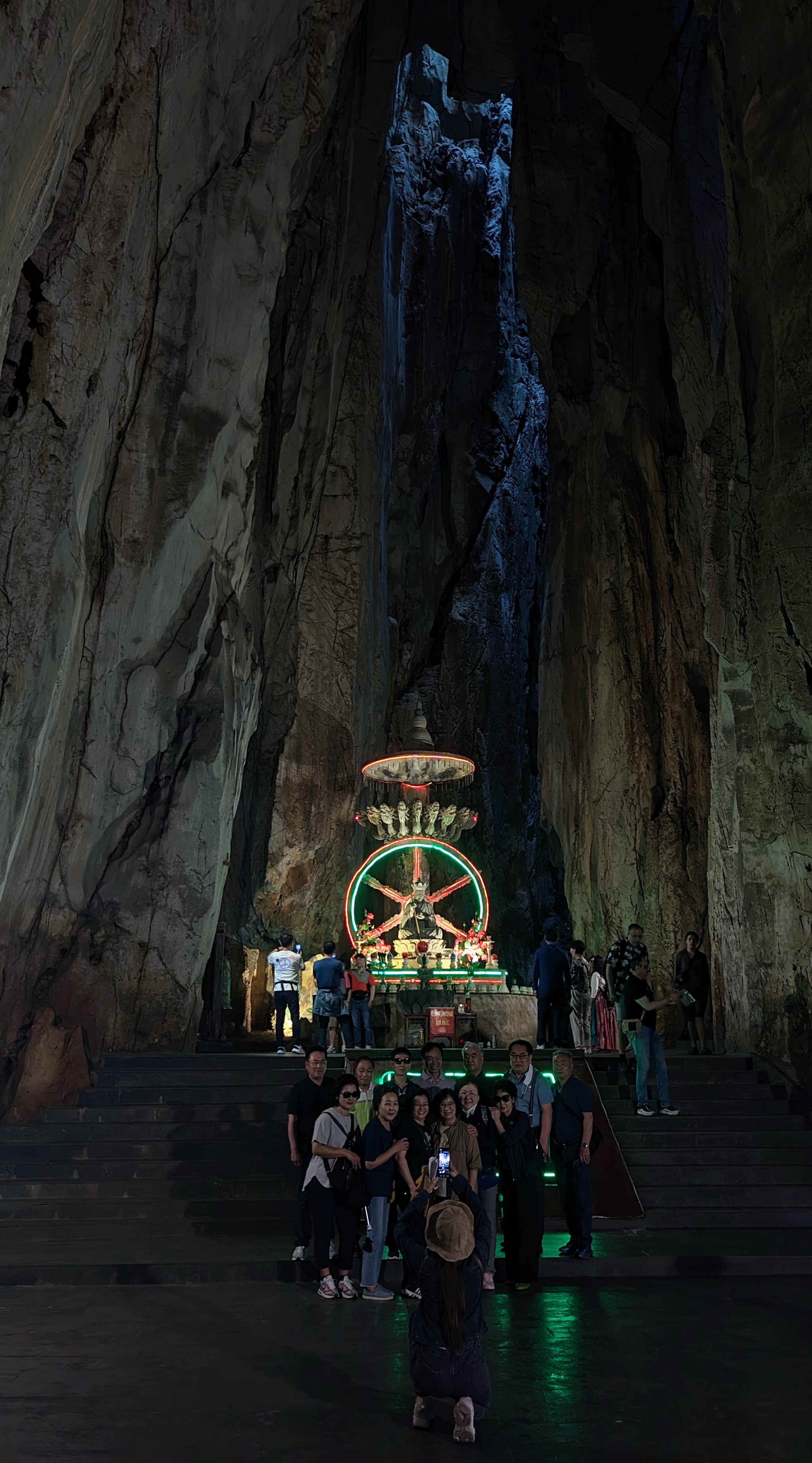
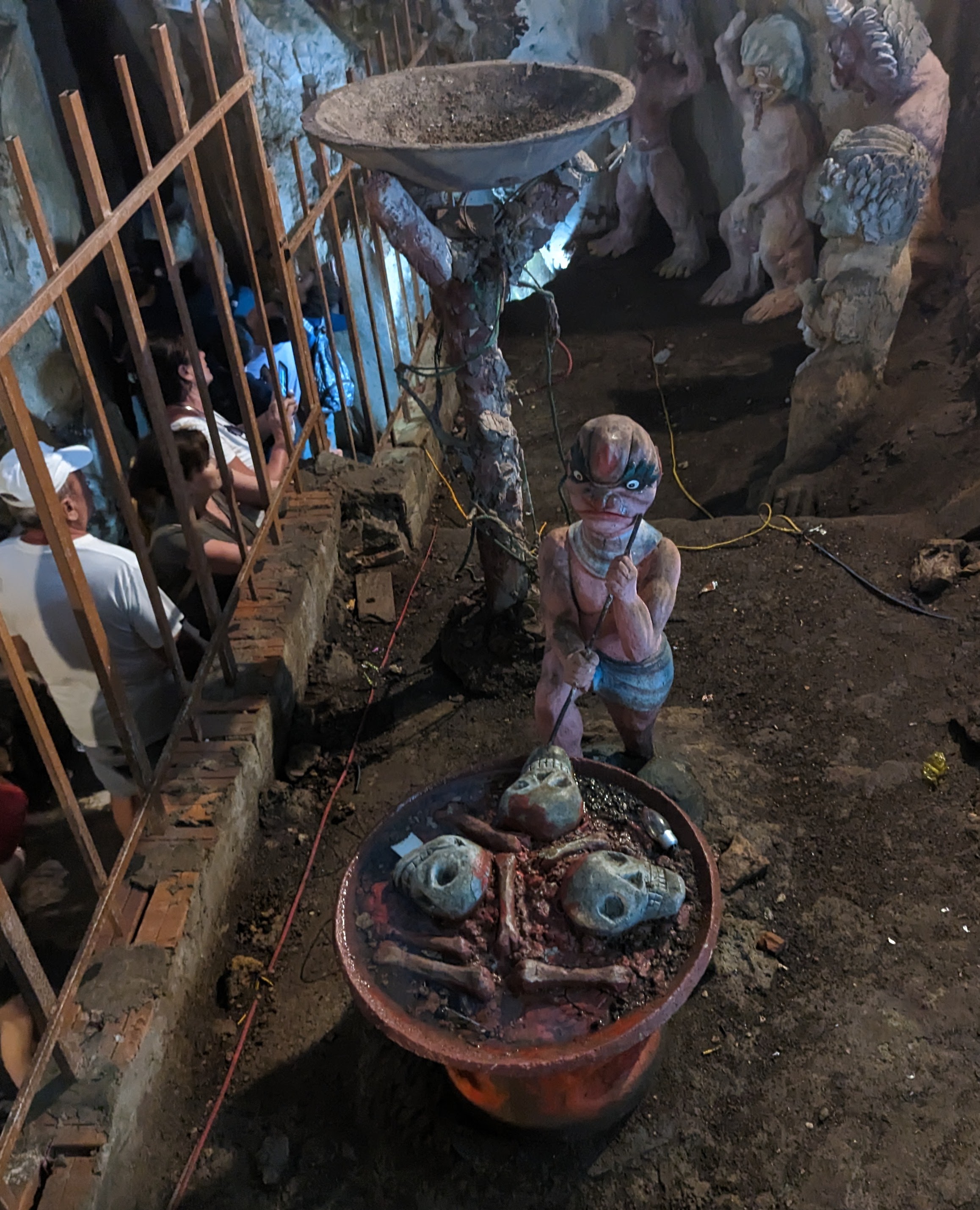
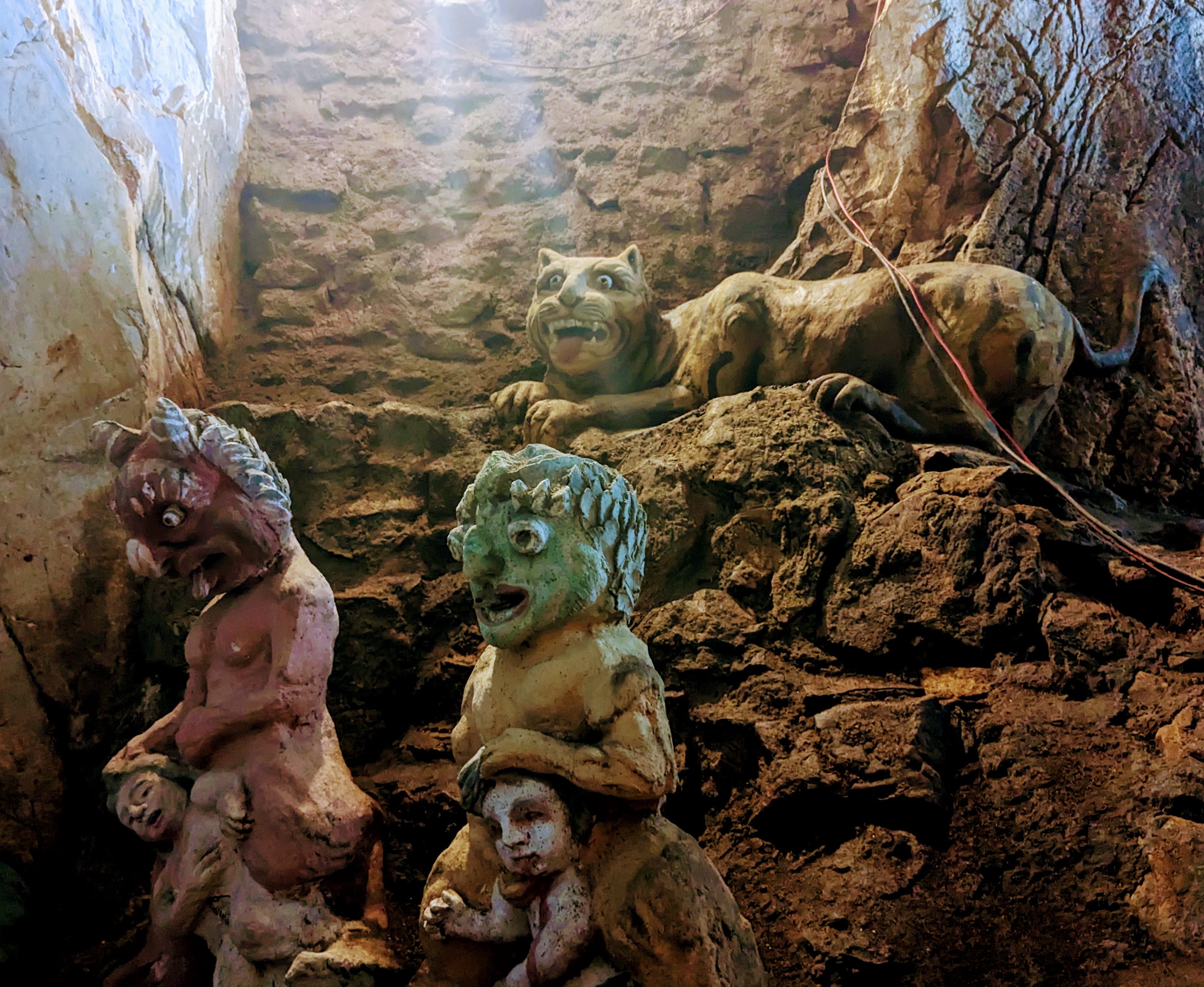
    ‘Am Phu’ means ‘Hell’ and was named by King Minh Mang on its discovery in the 19th century. The red glow around the marblework gives it a mildly hellish atmosphere. Incense hangs heavy in the air. It’s an impressive cave on its own, and the sculptures add to the sense of impending doom.

    This is one of the challenges that face you as you explore. A mirror that reflects your life back to you. You see all the good and the bad you have done on earth. After this, you are judged whether you are cursed to journey deeper into hell or whether you may ascend the steps to heaven. Fortunately, it was tarnished beyond repair so I managed to escape judgement. Either that, or it’s entirely accurate. I promise myself I will spend some of the weekend engaged in self-reflection and contemplation.

    The marble scales that judge you and either permit you to ascend to heaven or condemn you to eternal damnation.

    And as you can see, damnation looks pretty damned terrifying.

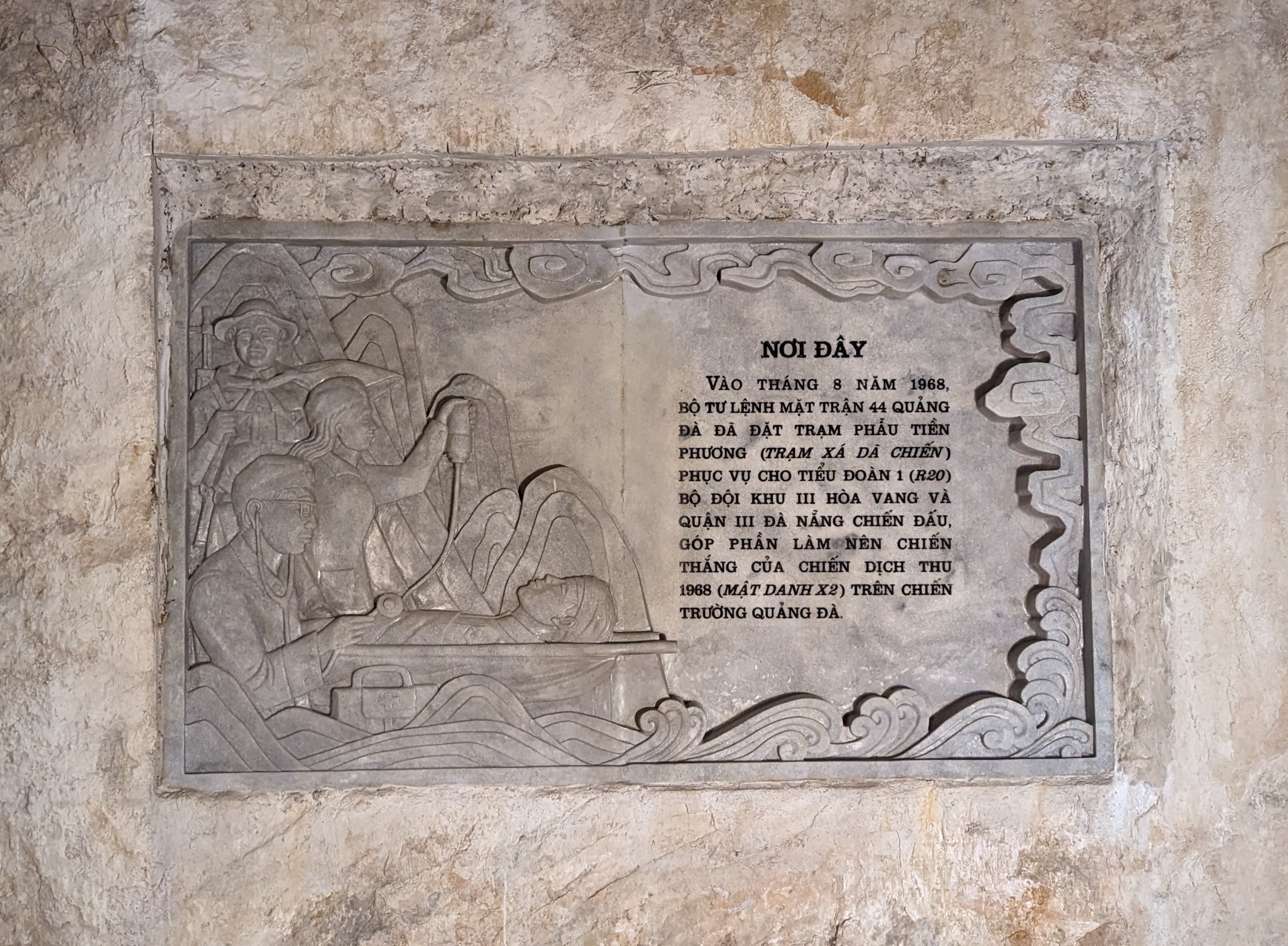
    The cave system was used as a military base and field hospital during the war.

    We exit Am Phu cave and decide, as a group, to walk the 150-odd steps to the top of the mountain. It is punishingly hot and, despite not being too challenging, I am drenched with sweat by the time we reach the top.

    Two guardians to the entrance of one part of the cave. The angry-looking fellow has an axe to deter evildoers, whereas the peaceful looking fellow is more than happy to let you in as long as you’ve managed to avoid upsetting the gods too much at this point in your life.

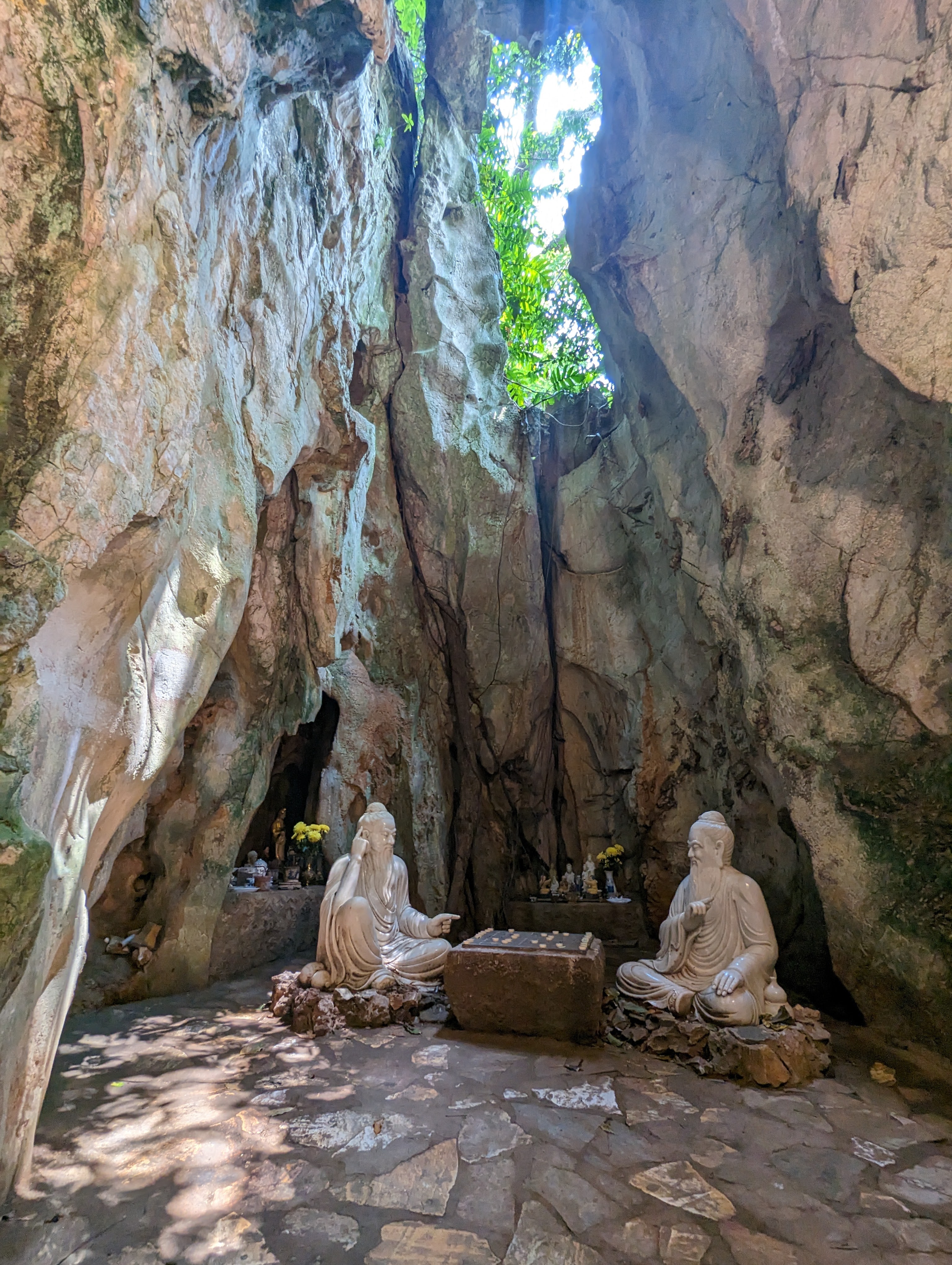
    This section is especially impressive, so I capture it with my lopsided, unimpressive skill. The roof of the cave was partially destroyed in a bombing raid during the war, and sunlight illuminates the area.

    The view from the top of Marble Mountain. It’s fairly impressive, so I decide to spoil it by sticking my awful head in it.

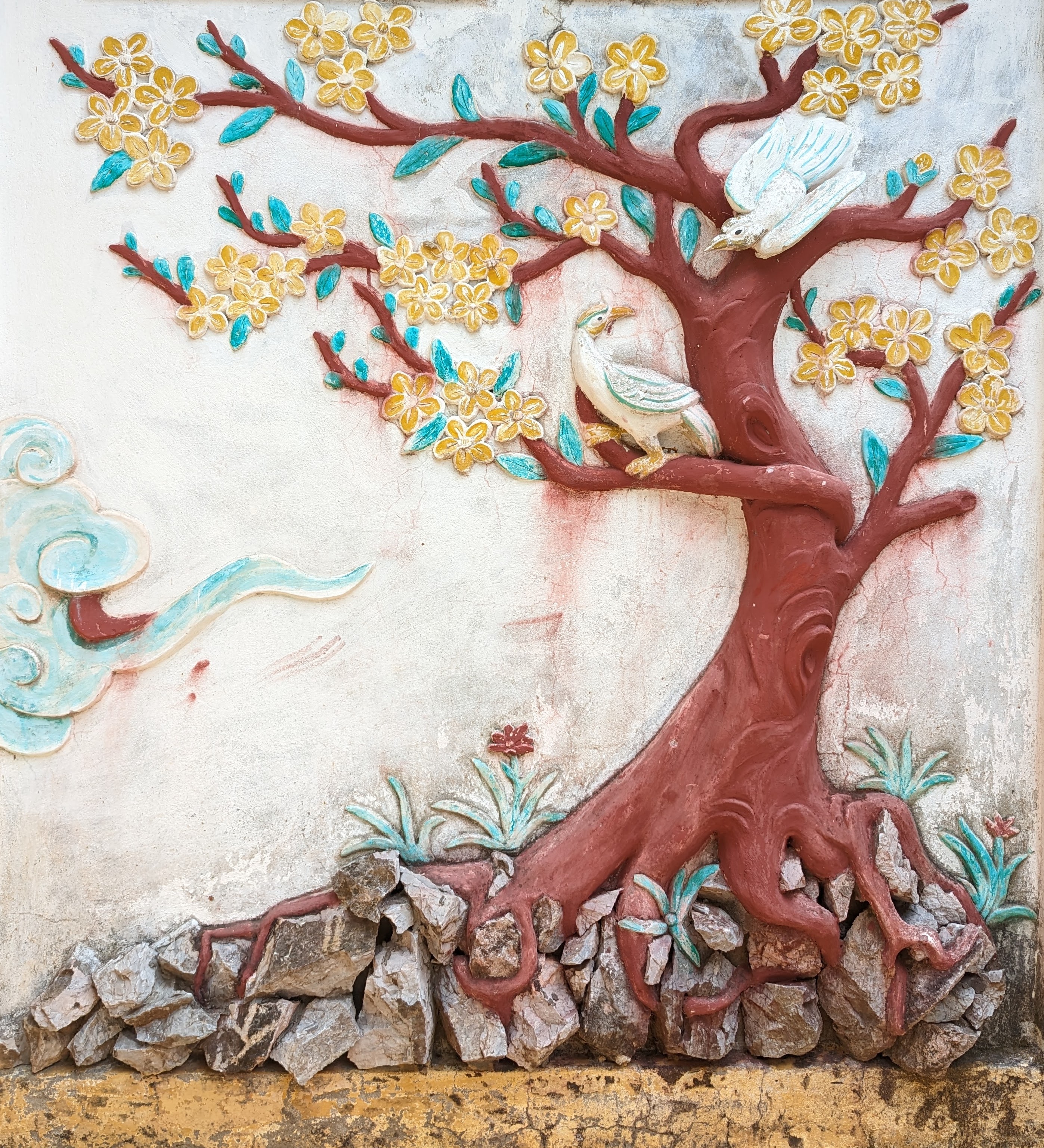
    One of the few painted reliefs on the wall of a temple at the mountain’s peak. It has an undeniable charm and the colours shine in the hot spring sun.

    Thank you to Lien from Venustravel – Travel in Viet Nam (venusvietnamtravel.com) for being a great guide and for having tremendous patience as I made my way down the marble steps towards the end of the tour. By the time I make it to the tour bus, half of the group have found, purchased and almost finished ice coffees.

    After a brief siesta at the hotel, I decide to make the most of the rest of the day. By this point, around 4pm, the worst of the sun has faded, a layer of cloud has settled and, in the right spots, a cool breeze blows.

    Which is good, because after a full day exposed to the elements, I am starting to feel the same as this poor little guy.

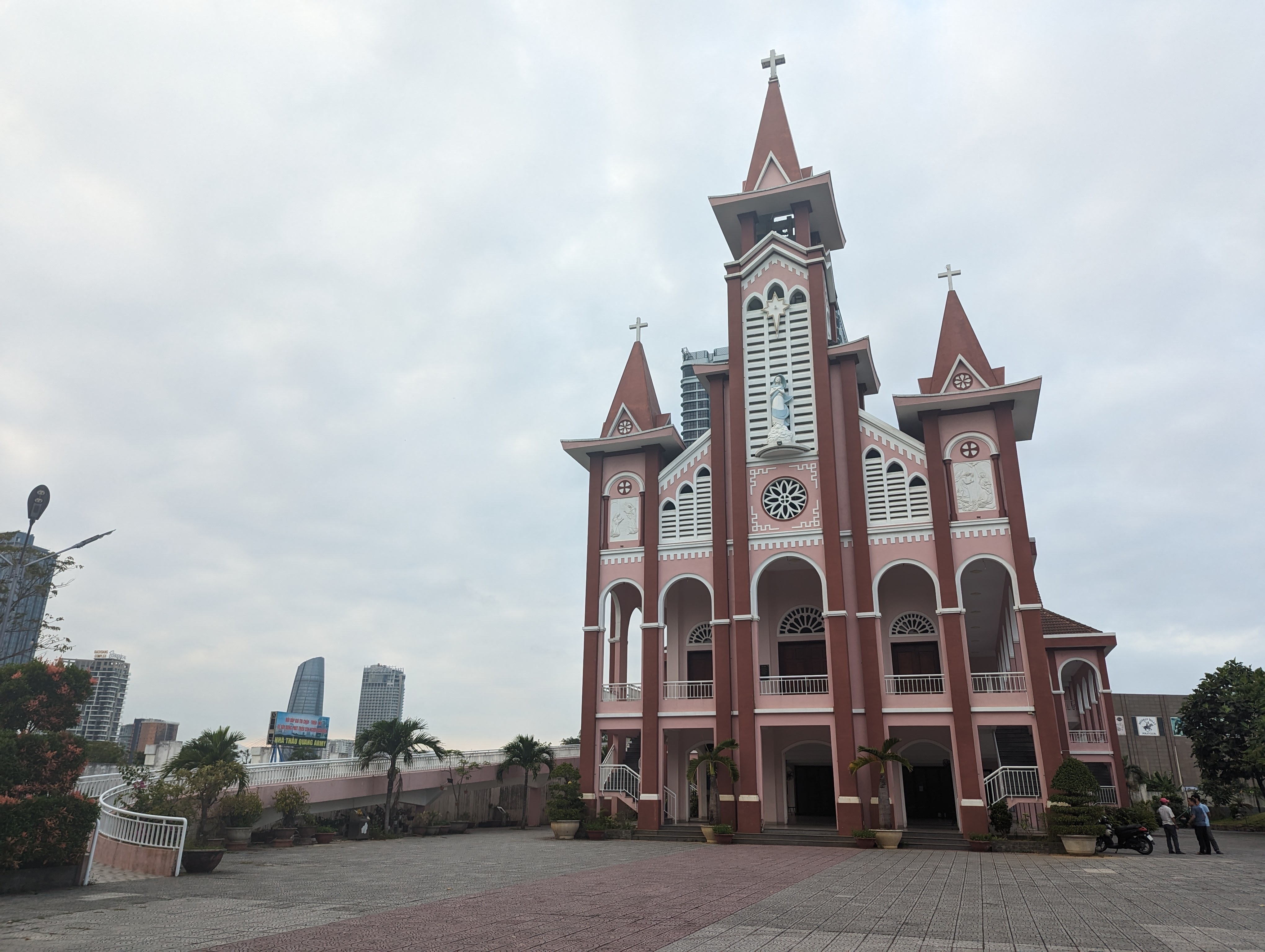
    Vietnamese churches have a distinct style. A unique fusion of various European styles, and in the case of Da Nang’s two largest churches, shining pink exteriors.

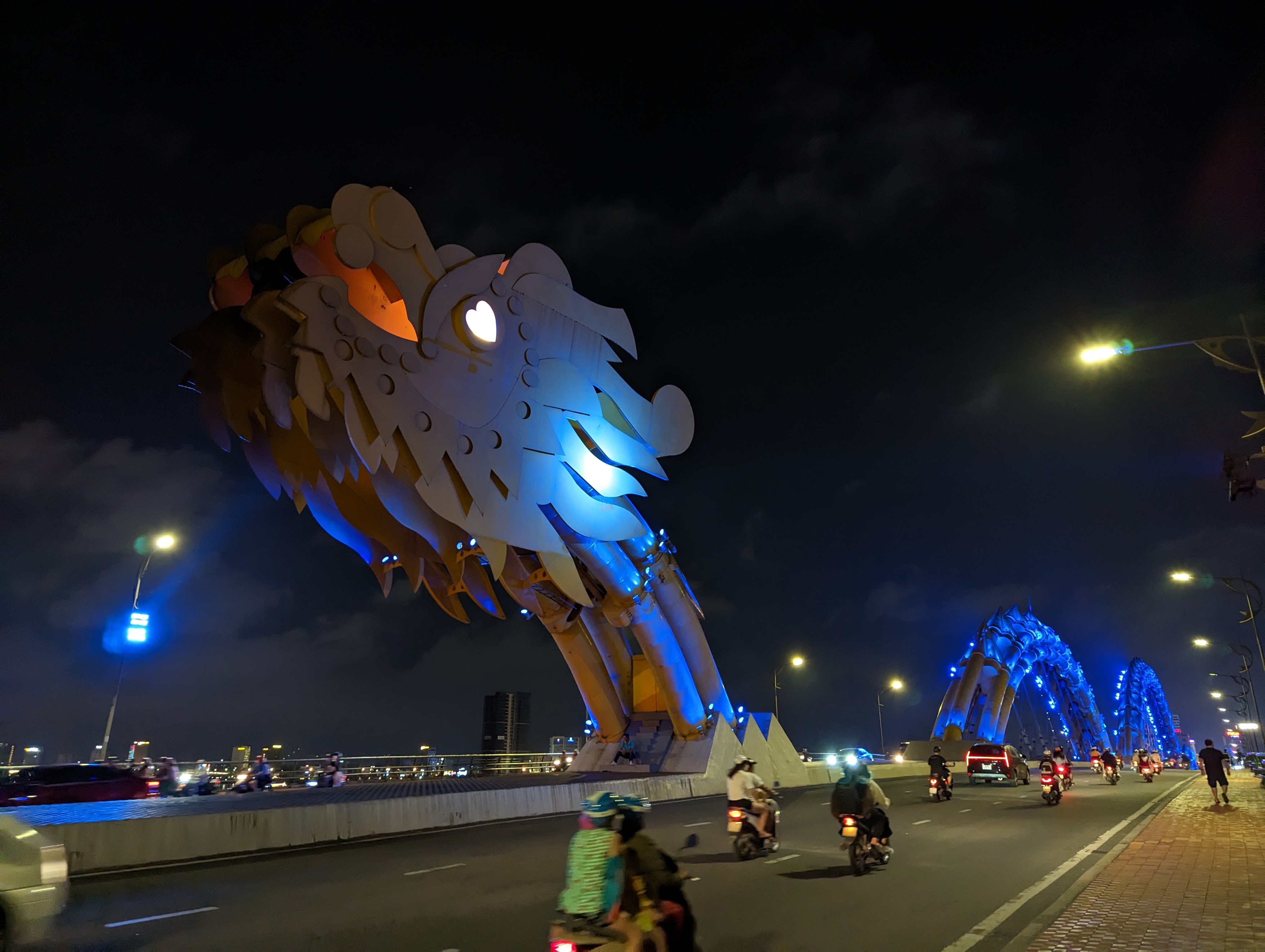
    I make it to one of Da Nang’s major tourist spots – Dragon Bridge. Every weekend at 9pm, thousands gather to witness the bridge breathe fire and spit water…

    …which is undeniably impressive. Close to the bridge is a night market with two large bars, vendors selling souvenirs, clothing, toys and electronics. Further along are three makeshift streets of stalls with fresh seafood platters, various barbecued meats and a range of deserts. It’s packed, but the atmosphere is good and there’s a jovial, welcoming feel to the whole place. If someone tries to sell you something and you say ‘No, thank you’, they leave you alone immediately, which I appreciate.

    I leave this area and walk along the bridge with a view to finding more adventure in central Da Nang city.

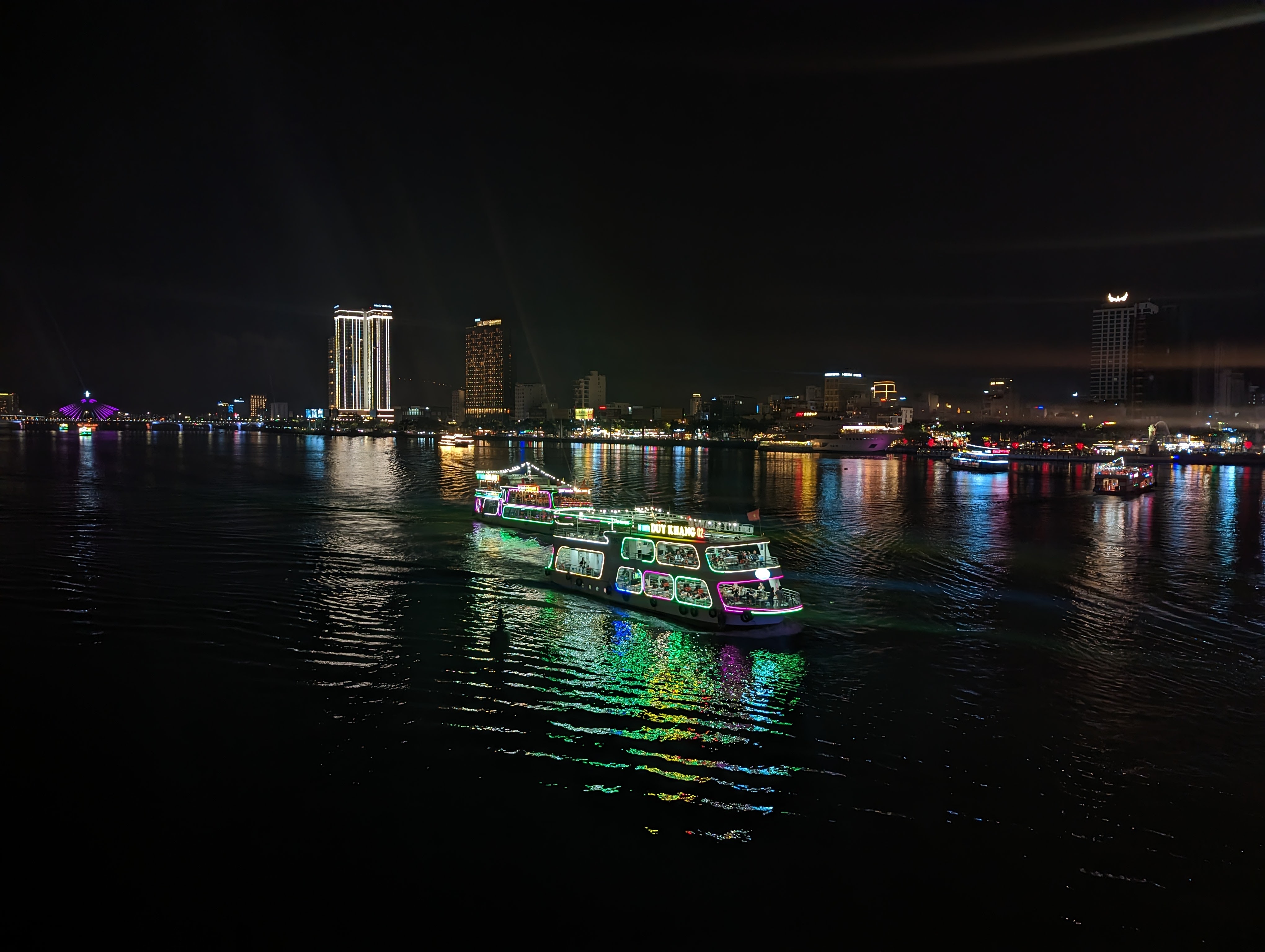
    Night cruises slowly crawl along the river and under the bridge.

    In central Da Nang city I find a bookshop and a corner coffee shop whose delectable black iced coffee only costs 15k VND (less than 50p). I wander around, nibbling a banh bao (more on those later) and reflect on the day.

    At this point my energy begins to wane. I have covered just over 17km on foot today and am feeling like it might be time to retire. I have much to do tomorrow and want to be in peak physical condition (read: ‘relatively peak’). I cross back over the bridge towards the night market, intent on getting an early night.

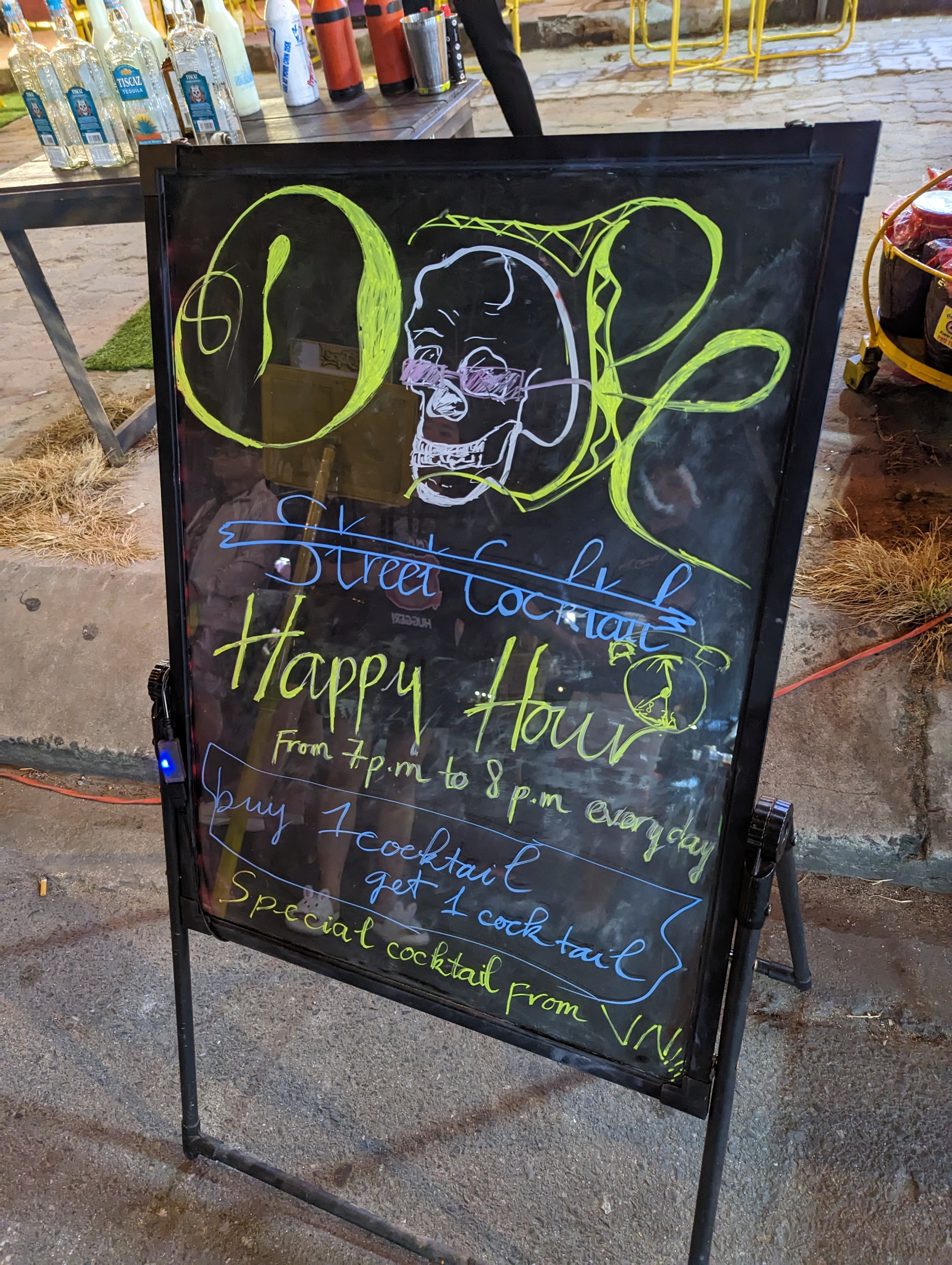
    As I teeter along on weakened legs, albeit refreshed by the evening breeze across the river, I stumble across the deal of the decade.

    To the top left of the picture, you can see a table full of bar flair props. A young man is rehearsing a routine with the plastic bottles ready for a performance later.

    It’s that rare kind of day when you feel like you have been blessed. The winds are behind you, pushing you onwards, and everything falls into place. I sit outside the bar with a cold beer and my book, Haruki Murakami’s ‘Colorless Tsukuru Tazaki’, a reflective and mournful work about loneliness, isolation and feeling distanced from those you love. As I said, everything was falling into place today.

    After a few pages and an unsuccessful attempt at conversation with some Australian casino managers, the bar flair juggler returns and put on a show. It’s impressive seeing him perform with the flaming props. He fumbles the balance at the end, but about an hour later he repeats the routine flawlessly.

    I finish my beer and decide that it’s time for dinner before heading to bed. A charming elderly couple lure me to their stall with delicious looking marinated pork and chicken. I sit on a traditionally tiny stool at a traditionally weatherworn table on a traditionally serviette and cigarette butt strewn street, and they bring me meat, salad and a beautiful chili and peanut dipping oil. Wrapped in rice paper, these hand-made rolls are the perfect end to a perfect day.

    But the day has one more surprise for me. As I amble home, I spy not one, but two Banh Bao guys chatting in the street. Why is this significant? Well, after a short time in Da Nang you get used to hearing the Banh Bao guys pootling down the road with their mobile kitchen-on-a-bikes. And, depending on the time and place, you may choose to exchange 20k VND (around 80p) for a delicious, fresh, steaming hot bao bun filled with pork, vegetables and a quail egg.

    Seeing one is fortunate, seeing two interacting is a blessing. Their speakers proudly announce their wares in off-kilter harmony. It’s a looped recording and every banh bao guy has the same. “Banh Bao! Bahn Bao Rai! Bahn Bao Dac Biet!” blasts out along the street. I will get a proper picture of the setup before I leave, but in summary it’s a motorbike with a rear-mounted open wood fire, a large pot full of very hot water, a large metal steaming cabinet and many gently steaming bao buns. It amuses me to consider the reaction you’d get from the police back home if you were found riding one of these around town centre.

    I am exercised, fed, watered and overall feeling wholesome and well. It truly was a gift of a day and I feel grateful to have been able to have these experiences. I tuck myself into bed before midnight and prepare for Saturday and the delights the rest of the weekend will bring.

  • Roborace and the Future of Autonomous Vehicles

    Mar 9th, 2023

    How are COMPANY playing a part in the brave new world of autonomous vehicle systems?

    At COMPANY, we often find ourselves at the forefront of automotive technology. We are certainly kept busy all year round, ensuring we are up to date with 3M’s advances in wrap materials, investing in state-of-the-art printing and production facilities including the industry-standard HP Latex 560 and providing on-site wrapping services for racing teams from Formula E to 24 Hours of Le Mans. However, there is one project that has kept us very busy over the last few years and continues to be the most exciting.

    Imagine the roads of the future. The shapes. The sounds. What can you see and hear? You’ve likely envisioned a world of existing technologies. Perhaps you heard the warming hum of electric engines, or maybe you saw the sleek, neon-tinged curves of a manufacturer’s sci-fi inspired concept model. Did the vehicles have drivers? If you’ve been paying attention to recent developments in vehicle design, then possibly not.

    The truth is, much of that vision of the future is already a reality, albeit still in the early stages of development. Everything, that is, apart from the self-driving vehicle. You may be forgiven for thinking that self-driving vehicles that exceed 160 mph would be a foolish venture. This conclusion doesn’t seem to bother London-based venture capital company Kinetik. They are the organisation behind the world’s first entirely autonomous racing championship. Bolstering their confidence in their technology even further is recent news that one of their pet projects, the Roborace vehicle ‘DevBot 2.0’, recently achieved a Guinness World Record title, with the 700 horsepower machine using its four electric motors to attain a speed of 175.49 mph, although thankfully not on the M25.

    Roborace is the world’s first completely autonomous racing tournament and COMPANY have been there since the very beginning, providing livery to all of its vehicles, trucks and trailers. Season Alpha is the first competitive season in this brave new world of technologically-driven motorsport. The brainchild of ABB and the FIA, who are clearly not content with pioneering clean energy motorsport solely in the form of Formula E, this algorithmic, autonomous event is currently well into its Season Alpha run and, if the events regularly broadcast on YouTube are anything to go by, are giving us yet another shining example of how future technologies are poised to change the face of motorsport. 

    Now let’s not fool ourselves here. This is motorsport unlike any other. It raises the question ‘Is this even motorsport at all?’ No human interaction? No fuel? No risk? What could possibly be the point? Well, whilst it may not instantly attract die-hard petrol-heads, Roborace is finding an audience amongst technicians, programmers and engineers, especially those with their eyes on the vehicle systems and intelligence technologies of the future.

    The current vehicle model, DevBot 2.0, is sleek, majestic and giddying in its beauty and would look great on any starting grid. If the futuristic curves are kindling a sense of nostalgia in your gut it may be due to vehicle designer Daniel Simon, who has worked as a vehicle designer for top-grossing Hollywood movies such as Tron: Legacy. Captain America and Oblivion. This really is motorsport for those who grew up on a diet of science fiction and space ships.

    Devbot 2.0 is the base model for Roborace. It has a potential top speed of over 200 mph and, similar to Formula E, every team is provided with the base DevBot 2.0 vehicle, and each is equipped with the same hardware including LiDAR technology. This laser-based radar system works by bouncing lasers from nearby hazards and creating a ‘picture’ of the tracks that the car is then able to navigate. Similar to the reversing sensors that are now ubiquitous in new models, these warn the vehicle as to its proximity to the hazards that surround it from hay bales to run-off areas. 

    There are currently two teams competing in Season Alpha, however many more are working behind the scenes to develop the AI necessary for competitive events. The inaugural race pitted the Technical University of Munich (TUM) against Arrival. The TUM team describe their goal as the continuing development of software. The engineers each work on sub-projects that will then contribute to the overall software architecture used in DevBot 2.0. They hope that this will lead to developments in autonomous production that can be applied to myriad autonomous vehicle applications in the future.

    Arrival, a technology startup based in Banbury and with their headquarters in London, also busy themselves with developing sustainable vehicles and electric technologies including an incredible smart electric van, and consist of a team of considerable experience with companies as varied as Audi, Jaguar and Apple. Recently announced entrants the University of Pisa will be participating in the next racing round, bringing to the competition the experience and knowledge of a university founded in 1343 and which was home to Antonio Pacinotti, the man who invented the dynamo in 1859.

    The teams are tasked solely with programming the Application Programming Interface (API), or artificial intelligence system to in layman’s terms, installed in DevBot 2.0. And we aren’t talking track maps or GPS coordinates, the vehicle is placed on the track and then completes several laps of increasing speed to create its perfect racing line. Initially, the vehicle receives invaluable feedback from a human driver. Autonomous mode is then enabled and the cars are left to forge their own paths and continually improve their lap times. Whilst this may sound relatively simple, teams have discovered that challenges such as autonomous overtaking can make life difficult on the track. All of these developments will lead to smarter, safer technologies on the roads as the lessons learned from the Roborace series are applied to real-life applications such as overtaking lorries and tractors, and navigating busy and unpredictable public spaces. According to Bryn Balcombe, Roborace’s chief strategy officer, the goal is for autonomous vehicles to drive “as naturally as a human but without the mistakes.” 

    You can watch COMPANY’s sterling work in the world’s first-ever autonomous race, held at Circuito Monteblanco, Spain and the expanding roster of participating teams promises even greater competition and drama in events to come. If the hopes of Roborace CEO and 2016/2017 Formula E champion Lucas di Grassi are to be realised, the series will eventually migrate to other categories and he even has his sights already set on F1 as a means to showcase the technology on offer and boost the competition’s profile.

  • Formula 1’s Electric Counterpart is Fighting Against Climate Change

    Mar 9th, 2023

    The batteries are still charging and the team are only just home following the end of the astonishing 5th Season of the ABB FIA Formula E Championship in July, yet the racing world is already waiting with bated breath for the 2019/2020 season to commence in Ad Diryah, Saudi Arabia this coming November. After a dramatic, and at times, chaotic doubleheader finale in the Big Apple, the world is asking itself if Vergne can continue his unprecedented winning streak in Season 6. The more important question, however, may well be ‘How is Formula 1’s electric counterpart helping in the fight against climate change?;

    “Our long-term vision is to power our events with 100% renewable energy by 2020 (beyond our cars).” ABB, 2019

    Formula 1 still dominates the motorsport world and, due to the astronomical levels of investment, unrivalled sporting history and millions of devoted fans across the globe, it continues to be something of a colossus that is unlikely to fall anytime soon. There are, however, many aspects to Formula E that are contributing to its burgeoning reputation as an industry leader, and one that may survive long after the fuel of Formula 1’s appeal has run dry. A key factor in this success is the FIA’s progressive and ecologically-minded approach to motorsports.

    “ISO 20121 is the international standard of sustainability for events… Formula E is the first-ever motorsport championship to receive this prestigious certification.” ABB, 2019

    ‘Sustainability’, ‘carbon-footprint’ and ‘climate change’ can be dirty words for many within the traditional motorsport community, raised on roaring engines and the intense aroma of petrol, oil and fumes. This is a reality that isn’t going to change any time soon, and rightly so. Formula 1 continues to display some of the greatest drivers and most remarkable innovations in technology the world has ever seen. What Formula E founders Jean Todt, president of the Fédération Internationale de l’Automobile (FIA), and Spanish businessman Alejandro Agag instead set out to do was give a greater focus to the electrification of the automobile industry. They saw the value of the development of electric and hybrid technology and, ultimately, working to reduce carbon dioxide emissions to create a cleaner, better world. The idea that Formula E was ever conceived as a ‘rival’ to Formula 1 is something of a misnomer. 

    “We race on temporary tracks in the hearts of some of the world’s leading cities, eliminating the need to build new infrastructure for each race.” ABB, 2019

    What cannot be ignored, however, is the fact that climate change and carbon emissions are dominating modern-day discussion in a way that has never been seen before. The UK has pledged to cut emissions to ‘net zero’ by 2050. Norway has settled on a national goal that, by 2025, all new vehicles sold will be electric or hydrogen-fueled and be zero-emission. And with cities consuming 78% of the world’s energy and producing more than 60% of greenhouse gas emissions, it is clear that showcasing clean, electric vehicles in the heart of some of the world’s most iconic cities is a vital step forward.

    London has its chance to shine in the 2019/2020 Season finale, with the world’s first indoor-outdoor race taking place in the heart of London’s Docklands. It is anticipated that this event will have the eyes of audiences across the world watching. It’s an an event that, up until six years ago, would never have been possible. Indeed, races through city streets in exotic locations around the world are one of the main draws of Formula E. Whilst some lament the lower speeds and comparatively quiet engines, this enables the ABB FIA championship to be incredibly creative in their locations, making for tight-knit, sharp-cornered tracks in the heart of some of the world’s most gorgeous cities. 

    “We use only 1 set of hybrid tyres per race, which were specially designed by Michelin to be suitable for all weather conditions.” ABB, 2019

    In the eight years since its inception, the standard car has been developed into its current, impressive Gen2 format, and there is little cause for concern left that sustainable technology will hold them back. The Audi-built Gen2 cars have a truly impressive list of statistics, including a top speed of 280 km/h (174 mph), 250 kW (335 bhp) maximum power and acceleration of 0-100 km/h (0-62mp/h) in 2.8 seconds. Considering that the Spark, Dallara and McLaren’s Gen1 car only began development in September 2012, the pace of technological improvement suggests some incredible advances to come in the future.

    The cars are essentially the same, meaning that driver skill plays a vital role in deciding the winner. Manufacturer teams are able to customise both the powertrain, which consists of an AC/DC converter, motor and transmission and the in-car software. The discoveries made during research and development in these areas will undoubtedly find its way onto the consumer electric car market in time.

    “We bring the race to city centres and encourage fans to use public transport or electric vehicle sharing. We purposefully do not provide parking spaces to reinforce this. We also have a great online platform where fans can watch the race live and in 360!” ABB, 2019

    Up until 2017, drivers were required to switch cars mid-race as the batteries were unable to power the car for an entire race and the logistics of swapping the batteries themselves wasn’t practical. With Season 5’s Gen2 model, McLaren Applied Technologies’ giant, 54kW/h lithium-ion batteries can last the duration of a race – 45 minutes +1 lap; a remarkable technological development considering the 200 – 250 kW power they’re outputting. McLaren’s development process shows no signs of slowing, as they have been chosen as the sole battery supplier by the FIA until 2020. Even more remarkably, the glycerine fuel the teams will use to generate the power, a dense, high-oxygen byproduct of biodiesel that combusts in an exceptionally clean way, is so clean and environmentally friendly, it can be safely drunk by humans, if that’s what you’re into.

    Organisers have worked tirelessly to ensure the reduced carbon footprint not only of the teams, but spectators as well, with plastic-free audience zones and the encouragement of fans to use public transport instead of their personal vehicles to attend races in these cities by refusing to provide parking spaces for spectators. It is refreshing to see this approach taken in the world of spectator sports, which all too often, even in this age of ever-expanding ecological awareness, place more importance on the bottom line than the world around them.

    “We are a proud ambassador of the EV100 programme and partner of the RE100 programme… The objective is to “make electric transport the new normal by 2030.”  ABB, 2019

    Impact has already been seen on the production lines of some manufacturer teams as well. Jaguar Land Rover will offer electric versions of all new models by 2020. Mahindra have announced a $139 million investment package to develop a battery module pack production line by 2020, which will develop its electric vehicle production capacity and help to inspire change across India. These developments, combined with the many more sure to come and the 3 million electric vehicles currently on the road bodes well for the future of sustainable transport, with Formula E at the forefront.

    There is so much more to respect and admire about Formula E’s approach to creating a better world through motorsport that it’d be impossible to contain it all in a single article. As the sport grows, so will the pioneering use of social media, virtual reality audience platforms and playable, real-time video games. It’s amazing to witness the devotion to working with charitable causes in the cities Formula E visits and the work that manufacturer teams, drivers and investors are doing to safeguard the planet’s future. If this brave new world continues to develop, perhaps Ernst & Young’s prediction that Formula E will help sell over 77 million electric vehicles, saving four billion barrels of oil by 2040, may well come true.

  • Is Car Paint Protection Film Worth the Investment?

    Mar 9th, 2023

    PPF, or clear bra, increases car finish lifespan, preserves value and saves on paint or vinyl repair.

    Paint Protection Film (PPF), alternatively called by the common commercial name ‘Clear Bra’, is an optically clear thermoplastic urethane film. It is installed on top of paintwork or vinyl wrapping and protects from scratches, chips and UV fading. Its fascinating history and varied benefits make it a product worthy of consideration for anyone interested in preserving the value of their investments.

    PPF was initially developed by the US military during the Vietnam War as a means of protecting helicopter blades, hence the common term ‘helicopter tape’. The technology was quickly developed so as to protect rotor blades and other sensitive equipment from flying debris and to be easy to install and replace in difficult and time-constrained environments. 

    Whilst the original material was notoriously difficult to apply due to low conformability (rotor blades are significantly easier to wrap than modern automotive surfaces), recent developments in technology have led to the easy-to-apply material we have today. Current PPF materials can be conformed to all but the sharpest of corners without the need for heat, requiring only a skilled hand and some soapy water for an effective, long-lasting application.

    There are many benefits to having a layer of PPF installed on your vehicle, including, but not limited to:

    • An extra-tough layer to protect your paintwork or vinyl wrap from scuffs, scratches and UV Colour fading
    • Preservation of resale value through increasing the durability and longevity of paintwork
    • Save money on costly and difficult paint and vinyl repairs.

     At COMPANY, we use the trusted PremiumSheild and Suntek films, incorporating a range of options from standard paint protection layers to advanced Elite Self Healing, UV-resistant products that can be remedied instantly with hot water and a microfiber car towel. These PPFs can be installed with a matt or a gloss finish, and are virtually invisible once fitted.

    The maintenance of PPF after installation is simple; treat it as you would any other paint or vinyl finish. PPF can also be waxed and polished with all but the harshest of products to ensure your vehicle always looks its best. Longevity varies from 5 to 10 years based on the quality and cost of the product you choose, and will eventually need replacing, revealing a finish beneath as perfect as the day the vehicle came off the production line. 

    More serious damage to PPF is easily treatable as panels can be replaced individually in next to no time. Be warned however; despite advances in technology, PPF is still best left to the experts if you want a flawless finish that’ll last for years.

    For all enquiries into PPF,  including costs, aftercare and advice on how to ensure your paint or vinyl finish stays protected, contact us to book a consultation.

  • Reflective Vinyl – 3M, Oralite Products & Vehicle Visibility

    Mar 9th, 2023

    One of the most common enquiries we get at COMPANY) is “How can I make my design more visible?” 24-hour on-the-road commercial vehicles, emergency fleets and those that are just after a little daytime sparkle or night-time shine can all benefit from understanding the broad advantages and certain limitations of reflective vinyl, or reflective print media (RPM). To further investigate this question, we spoke to our materials expert and production supervisor, David.

    What is reflective vinyl?

    “Reflective vinyl has a layer of glass beads that reflect the light from vehicle lights and other sources, followed by a thick, clear gloss film on top… it  is great for an extra ‘pop’, and stands out well against everything around it.”

    As mentioned above, there are many reasons, practical and commercial, for making your vehicle stand out from the rest. The process behind the making of reflective vinyl gives it its unique properties, using advanced reflective technologies and cutting-edge production techniques. Developments in reflective vinyl also mean that it can be used in almost all the applications that regular vinyl wrapping materials can, as it can be wrapped on all but the most extreme of shapes with little to no bruising.

    Where do you see the most demand for reflective vinyl?

    “It is most commonly used within the emergency services, and is essential for industries that require fleets on the road 24 hours a day, such as highway maintenance and vehicle recovery.”

    ‘High conspicuity livery’, as it is referred to in the emergency services, has several significant benefits, including:

    • Block fluorescent colours make the vehicle appear larger and, therefore, more visible.
    • The human eye is particularly effective at identifying flashing and reflected light in its peripheral vision.
    • Fluorescent colours provide the strongest contrast with the greys, blacks and whites most commonly found in the typical road environment.

    Dr Paul Harrison, Home Office


    Whilst these elements are essential in environments with a high volume of traffic, they can also be used for commercial and personal liveries. One look at our work with reflective vinyl in the past will evidence just how effective this high impact media can be in getting your vehicle, and therefore your brand noticed. 

    What projects have you completed using reflective vinyl?

    “We have worked with local company Harke Electrical, the Team Redmist drift British Drift Championship 2017 team and we also installed reflective elements onto the 3M & Spandex ‘Cool Cars’ competition-winning Rolling Stone Ligier JS P2-Hondas for Extreme Speed Motorsports at 2015’s24 Hours of Le Mans.”

    Far from being limited to high conspicuity block colours on emergency vehicles, our team of experienced designers and installers can incorporate reflective vinyl into a wide range of designs, adding glistening detail to more complicated concepts, or ensuring whole panels are visible in potentially hazardous environments.

    What ‘go-to’ brands are the most trusted by the team?

    “3M Scotchlite 780mC is the only reflective that is intended to be printed on, but we will also print on Oralite 5200, 5300 and 5400 materials if the application isn’t too extreme in the way of curves.”

    As a 3M Authorised Vehicle Wrapper, you won’t find a better place to install 3M’s unique, printable vinyl, which can be fully customised to any design and fitted to the majority of common surfaces, including simple curves, compound curves, concave surfaces, corrugations and flat surfaces both riveted and unriveted. And with a durability of up to 9 years, wide retroreflective viewing angles and heat-recovery properties and an easy apply and remove micro-technology Comply™ Adhesive, you’d be hard-pressed to find a better material for your reflective requirements.

    For all enquiries into reflective vinyl, other reflective media and advice on how to make your vehicles highly visible, safer and more noticeable, contact us to book a consultation.

1 2 3
Next Page→

Blog at WordPress.com.


Loading Comments...
 

    • Subscribe Subscribed
      • Max Lawrence Writes
      • Already have a WordPress.com account? Log in now.
      • Max Lawrence Writes
      • Subscribe Subscribed
      • Sign up
      • Log in
      • Report this content
      • View site in Reader
      • Manage subscriptions
      • Collapse this bar